
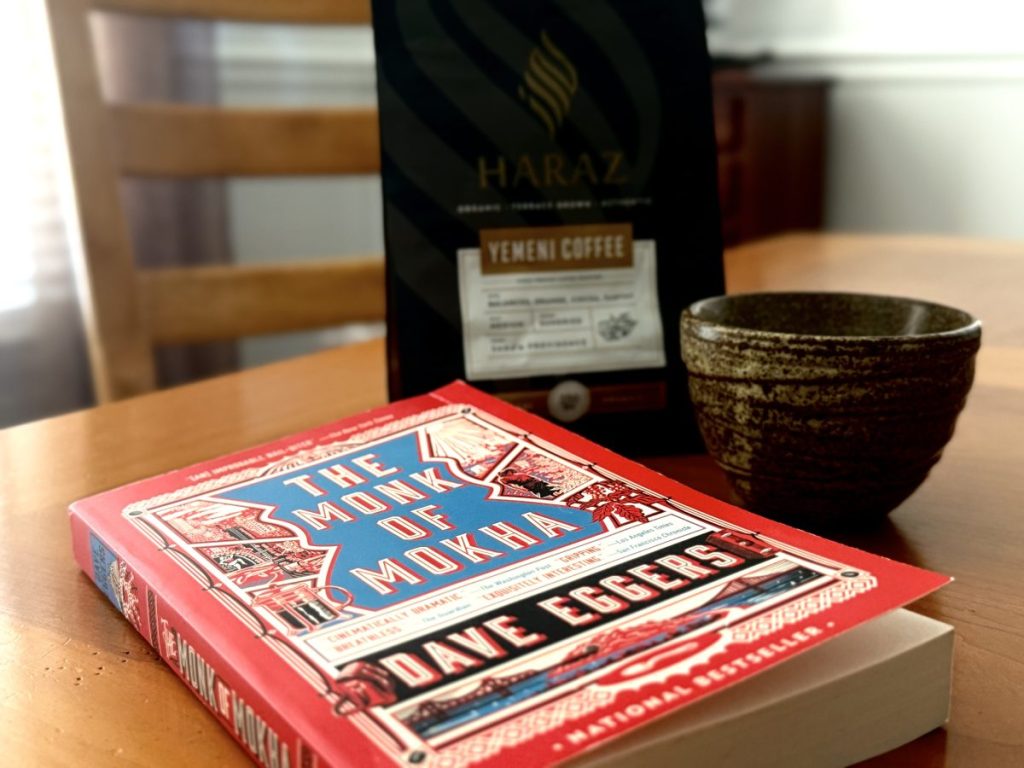
There is a line in Dave Eggers’ book The Monk of Mokha that stopped me cold the first time I read it. Describing what it takes to bring a single cup of coffee to your hand, Eggers writes: “Any given cup of coffee might have been touched by twenty hands, from farm to cup.” Twenty hands. And yet we pick it up, sip it, set it down, and move on with our day without a second thought. Retirement has given me the gift of the second thought.
I retired and living in Hendersonville, Tennessee, and I have taken up what I can only call a coffee pilgrimage as a serious hobby. Not collecting. Not cataloguing. Just driving, sitting down, ordering something beautiful, and paying attention. It turns out that paying attention to coffee leads, rather naturally, to paying attention to everything else: the person behind the counter, the story behind the bean, the region of the world that gave it life, and the long human chain Eggers describes so vividly in his remarkable book.
Eggers tells the true story of Mokhtar Alkhanshali, a young Yemeni-American man who, at twenty-four years old and working as a doorman in San Francisco, discovers the astonishing history of coffee and Yemen’s central place in it. He eventually travels to Yemen, navigates civil war, and brings Yemeni specialty coffee back to the West for the first time in nearly a century. It is a breathtaking story. But what drew me to it was something quieter underneath all the adventure: the idea that a cup of coffee is not a commodity but a conversation. A conversation with farmers, with history, with a region of the earth that cares deeply about what it grows.
I thought about that often during a recent Tuesday morning at Haraz Coffee House on Woodland Street in Nashville. Haraz is a Yemeni coffee shop, and if you have never sat with a cup of their Harazi mufawar, the traditional Yemeni coffee served with cardamom and cream, you have a trip to plan. The cup is thick and generous, full of cocoa, dried fruit, and baking spice, with a finish that lingers like a good conversation you do not want to end. It is exactly the kind of coffee Mokhtar was fighting to share with the world.
And yet it is also completely different from my other great coffee love: Ethiopian. I have been chasing Ethiopian coffee for years, most memorably at Farmer’s Horse Coffee in Boston, tucked into Back Bay near Symphony Hall, owned and operated by Ethiopians who import and roast their beans in small batches right in the city. Where Yemeni coffee is dark and contemplative, Ethiopian coffee from the Yirgacheffe region is bright and almost lyrical. The tasting notes read like a poem: jasmine, bergamot, lemon, stone fruit, a clean high-toned sweetness that lifts off the cup like something fragrant in a spring garden.
The contrast between the two is worth sitting with. Think of it this way. Yemeni coffee from Haraz or Mokha tends toward brown sugar, dates, and raisins in the fruit notes; rich cocoa and baking chocolate in the sweet range; cardamom and clove in the spice. The body is full and velvety, the finish long and warming, like the last pages of a novel you were not ready to finish. Ethiopian Yirgacheffe, on the other hand, gives you citrus and berries up front, honey and cane sugar sweetness in the middle, and a finish that is clean and quick, like a bright poem that ends before you expect it to, leaving you with one sharp image. One is an epic. The other is a lyric.
Eggers captures something close to this distinction when he quotes a lesson about roasting: “A good coffee should be roasted gently, in small batches, and lightly.” That single sentence explains a great deal about why the coffees I love most taste the way they do, and why certain well-known chain coffees feel like they are shouting when these smaller, origin-driven shops are quietly reciting verse. Both have their place. But I know which voice I prefer on a slow morning.
Recently I discovered Mocha Point Coffee in St. Charles, Missouri, another Yemeni shop doing remarkable work, and it deepened my conviction that this wave of Yemeni coffeehouses across America is one of the genuinely interesting things happening in our food culture right now. These shops are not just serving good coffee. They are doing what Mokhtar Alkhanshali set out to do: using the cup as a bridge, connecting American coffee drinkers to a culture, a history, and a set of farmers most of us would never otherwise encounter.
I live in Hendersonville. There is no Yemeni coffee shop here yet, no Ethiopian roaster in a converted garage doing small-batch Yirgacheffe. So, I drive to Nashville, which is not a hardship. I have Haraz and Kahawa and Crema Coffee Roasters, each offering a different voice in the same long conversation. And I have discovered that the drive itself is part of the ritual, part of what Mokhtar understood when he chased his dream across mountains and civil war: that the best things require a journey, even a small one, and that the cup waiting at the end of the road tastes better for the traveling.
Retirement, it turns out, is not the end of the pursuit. It is the beginning of being unhurried enough to actually taste what you find.

