
“Good morning, Tennessee Jim.”
I hear it every time I walk through the door at Caffè Vittoria on Hanover Street in Boston’s North End. Before I’ve said a word, my cappuccino and biscotti are already on their way to my table. Four years of visits. One barista who simply paid attention. It is, I’ve come to believe, a small and perfect example of what coffee has always done best.
Coffee gathers people. It always has.
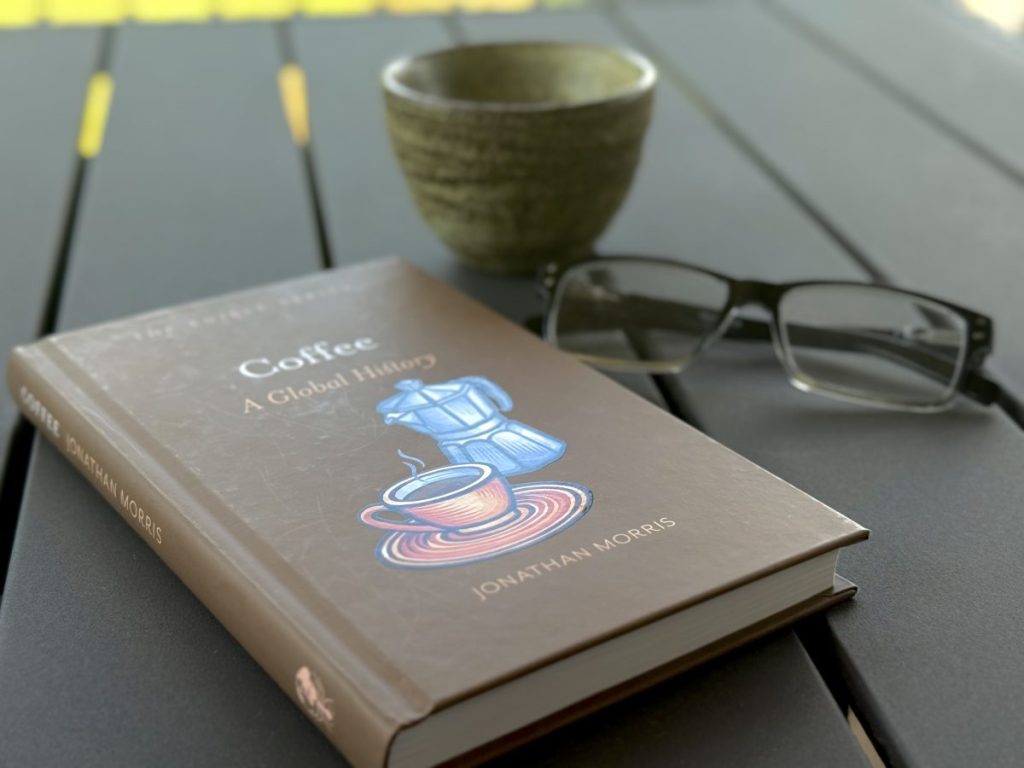
I’ve been making my way through Coffee: A Global History by Jonathan Morris — a book I read a few years ago and still return to periodically, turning its pages the way you might revisit a favorite café. For some the subject might seem narrow. It isn’t. Morris traces the journey of a bean from its Ethiopian and Yemeni roots through centuries of trade, culture, and what he calls the “waves” of innovation that shaped the drink we know today. There is something quietly wonderful in considering how coffee has, as I’ve come to think of it, used us to improve and grow its presence on the Earth.
But one idea in the book stopped me cold. Coffee first made its way into Europe through the Ottoman Empire, finding its home in the early coffeehouses — places described as alcohol-free venues for socializing where customers were treated as equals.
Treated as equals.
Caffeine is a stimulant. Alcohol is a depressant. And nobody needs to know if you’re drinking decaf. But set that aside — what drew me to that phrase wasn’t the chemistry. It was the equality. The idea that something as simple as a shared cup could level a room.
I’ve seen it happen.
About six years ago, at that same corner table at Caffè Vittoria, a simple question led to a conversation with a couple visiting from Italy. It happened that my family and I were planning our own trip to Italy just six months away. By the time we parted, they had filled four pages of my notepad — places to see, things to do, neighborhoods to wander in every city on our itinerary. The young woman gave me her email address and told me to write with questions. I did. She answered every one.
Almost exactly one year later, same café, same corner of Hanover Street, I met a father and his two daughters visiting from Germany. Another simple question. Another conversation that expanded well beyond what either of us expected — stories exchanged, laughter, that particular ease that seems to arrive when the cups are warm and nobody is in a hurry. About seven hours later, in the lobby of the Boston Public Library, we came around a corner and there they were. The father’s face opened into the widest smile.
“What kind of magic is this?”
I’ve been thinking about that question ever since. There are an estimated one billion coffee drinkers in the world. One billion people who begin their day, or pause their afternoon, or end their evening with the same simple ritual. Most of them — I’d be willing to wager — have a place. A table. A barista who knows their order.
Maybe that’s not a small thing. Maybe coffee has been quietly doing this all along — gathering strangers, softening the distance between people who would otherwise never speak, reminding us that we were always more equal than we remembered.
Pull up a chair. The coffee’s on.

