This is Part 4 of a four-part series, a broad conversation about reading and what it does to us over time. No category, no prerequisites. All are welcome at this table. The Table of Contents for this series can be found here.
Three posts ago I told you there was a book missing from my spreadsheet. Three hundred ninety-eight rows, and the one I have spent the most hours with in my entire life appears in exactly none of them. I promised I would come back to it, so here we are.
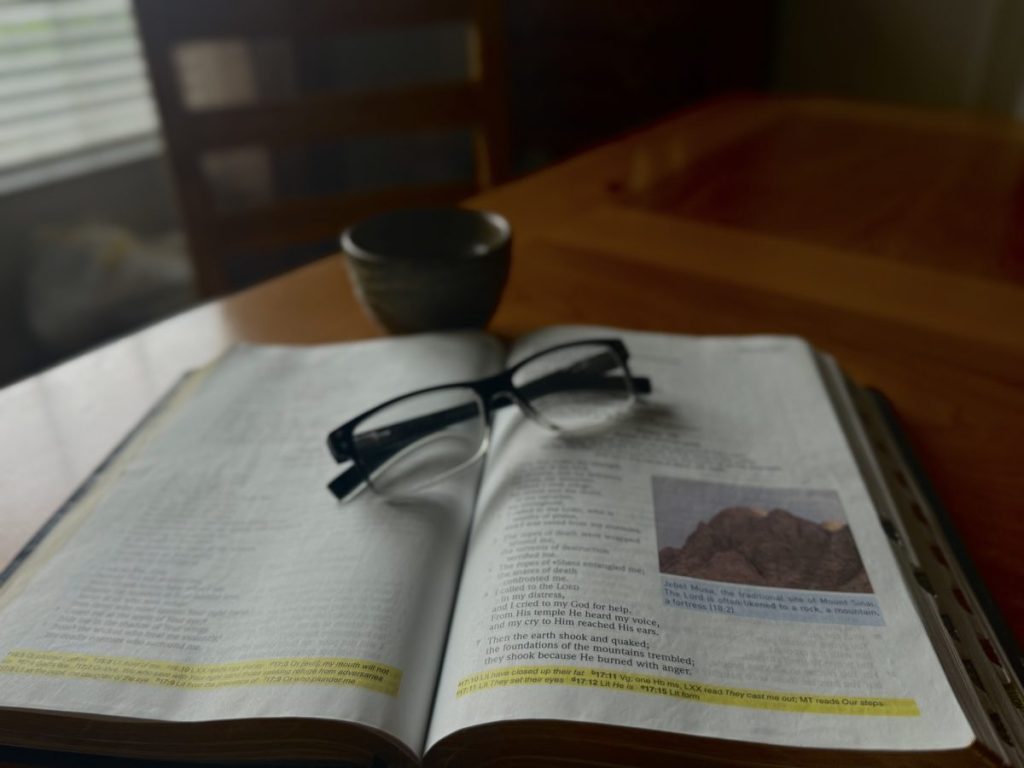
It is scripture. I read it, and study it, roughly five to ten hours a week, week after week, year after year. Do the arithmetic and it comes to something like three or four hundred hours a year, more than every logged book on that spreadsheet added together, and Goodreads has no idea it exists. There is no cover to scan, no star rating that would mean anything, no date I finished, because I never finish it. It is not a book I read. It is closer to the water I swim in, the thing I said back in Part 1 and meant literally. You do not log the water. You just live in it.
I want to be honest about what that omission taught me, because it surprised me more than anything else in this whole exercise. I set out four posts ago to study my reading life using a spreadsheet, and the spreadsheet, for all its honesty about seasons and authors and thematic drift, turned out to have a blind spot at its exact center. The most formative reading I do is invisible to the tool built to measure my reading. That should have felt like a failure of the project. Instead, it felt like the truest thing the whole project had to say. Our record of ourselves is never the whole of ourselves. There is always a river running under the house that the inspection report never mentions.
Once I let myself see it, I could not stop seeing how much that unrecorded reading has been doing underneath everything else in this series. Go back and look with me for a moment. The Psalms taught me my first lessons in poetry, in metaphor, in the plain fact that grief and praise can occupy the same breath, long before I ever sat down with Mary Oliver. The story of Genesis has been sitting quietly beside Gilgamesh on my current nightstand, two ancient accounts of flood and formation, each one making me read the other more carefully. The Hebrew imagination behind the text I study every week is the same imagination I went looking for in The Bronze Bow and in David Fohrman, the same culture I confessed in Part 2 that the West may not have carried across intact. Even the Church stood behind every painting in that Roman chapel that stopped me cold, the one I wrote about after seeing Caravaggio’s light fall across a canvas the way it must have fallen across the first witnesses. None of that reading shows up as a row in an export file. All of it shows up as the person who was doing the exporting.
This is, I think, the real answer to the question this whole series has been circling. I set out to study my books. What I actually found was that my books had been quietly studying me, and that the deepest study of all was happening in the one place no spreadsheet could see it.
I want to draw the three seasons back together here, because I think this is where they finally make sense as one story instead of three. The systems reader, taking books apart to see how the brain and the gene and the body worked. The teacher, reading in service of students who needed a subject made alive. The retired man, finally reading for his own formation, letting Hawthorne examine his Puritanism, letting Atwood hand him a key, letting a children’s book about the Iliad walk him toward Homer. Underneath all three seasons, unlogged and unbroken, was the reading that never changed, five to ten hours a week, holding the other three still together like a keel under a ship that keeps changing its rigging. I did not become a different reader in retirement so much as I finally had the room to let the reading, I had never stopped doing shape everything else I was reading.
I do not say any of this to prescribe scripture to you as the answer to your own reading life. That is not the spirit of this table, and it never has been. I say it because I think every one of us has water we swim in, whether we would call it scripture or something else entirely. A practice, a person, a place, a discipline that never shows up on the record but that quietly sets the terms for everything the record does contain. You may not call yours a text at all. It might be a conversation you return to, a walk you take, a person whose voice you still hear when you are deciding what kind of person to be. I will say this much, though. If you asked me directly where to start looking, I would tell you. I would point you toward the book that has done it for me. But I would rather you ask than have me assume, and I would rather you find your own water than borrow mine secondhand. I would gently ask you to go looking for it the way I finally did. What is the thing in your life that is doing the most formative work and getting none of the credit?
Here is where this series ends, four posts and one spreadsheet later, though I suspect it does not really end so much as hand itself to you. I set out to keep a record of my books. What I found, instead, was that my books, all of them, the logged and the unlogged, the ancient and the children’s, the ones I dodged for thirty years and the ones I read too early to understand, had been keeping a record of me the entire time. Writing me, a little, with every page. I think that is quietly true of you too, whatever sits on your shelf and whatever water you swim in.
So here is my last invitation at this table, at least for this series. Start anywhere. Read the book you were supposed to read. Read the children’s version if that is the door that is open to you. Go looking for the unrecorded reading that has been shaping you all along, and give it its due. The change does not wait for you to have the right list or the right order. It comes with the reading itself, quietly, the way it came to me at a keyboard on an ordinary Monday morning with coffee going cold beside me and a spreadsheet open that I thought was going to tell me about my books.
It told me about myself instead. I have a feeling yours will too.

