
It was a warm, drizzly September morning in Rome. I walked cobblestoned streets to arrive at Santa Maria del Popolo, navigated my way up the stairs, and stepped into the Cerasi Chapel. There, positioned above my head among a grouping of three paintings, was The Conversion on the Way to Damascus by the Italian Baroque master, Caravaggio. So how did I really arrive here, standing before this masterpiece? It was, truly, a much longer road than that two-mile walk that morning.
My retirement opened an unexpected door into the full spectrum of art. While it began with rekindling a love for reading, it quickly expanded into other forms of artistic expression. The primary catalyst was a daughter moving to Boston for her career, and being retired, that opened opportunities to visit far more often than I ever expected. She moved into a neighborhood within three blocks of the Museum of Fine Arts. Well, my curiosity got the best of me, and an annual membership kept the door wide open to visit the MFA at my leisure.
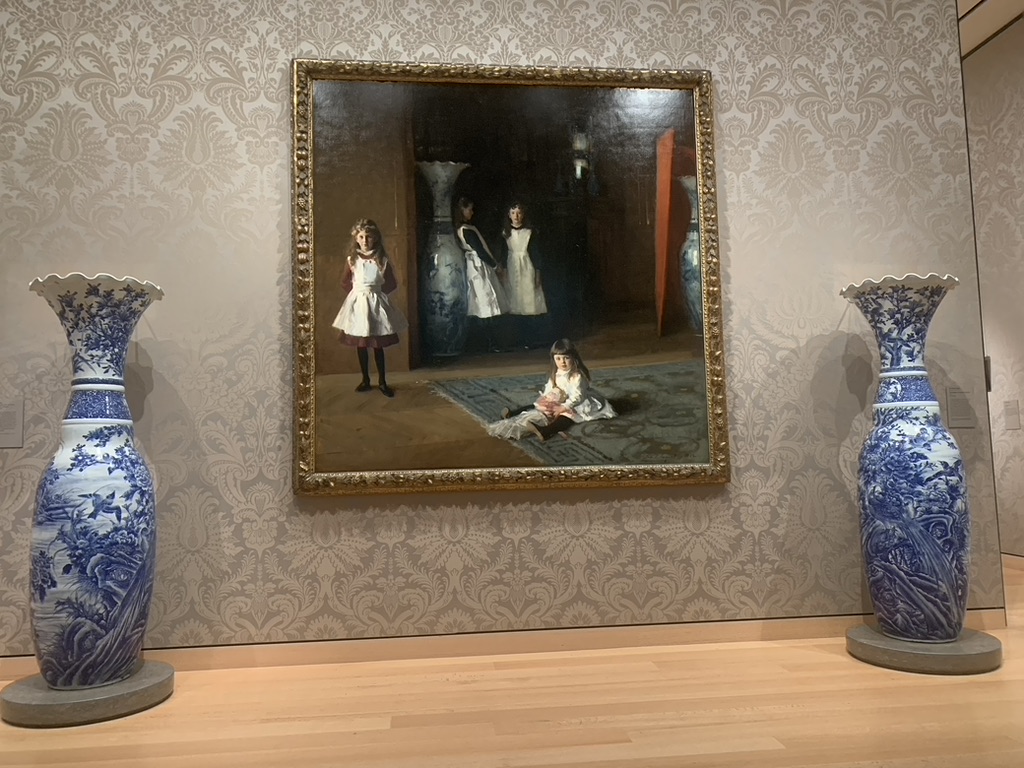
It wasn’t long after strolling through the Egyptian, European, and Flemish galleries that I stepped through the glass doors into the Art of the Americas wing, where Sargent’s Daughters of Edward Darley Boit waits in its shadowed corner. And I stopped.
As if the museum knew this painting would stop a person or two in their tracks, a small couch was positioned directly in front of it. I sat down, right in the center, and looked at that picture centered between two towering blue-and-white Japanese porcelain vases, those silent guardians of the Boit daughters’ dimly lit world. I sat there for a while.
That very day I felt the gates fly open. A newly ignited desire to seek out more paintings, more artists, more of everything took hold. I walked the full gallery searching for every piece of John Singer Sargent’s work the MFA displayed. Then I discovered the Monet gallery just up and around the corner. I revisited the Flemish galleries and familiarized myself with Peter Paul Rubens and Anthony van Dyck.
Over the months and years since that afternoon, I have visited the Harvard Art Museums, the Isabella Stewart Gardner Museum, where I was introduced to the magnificent work of Whistler, and a growing list of galleries, artists, paintings, and cities that just keeps expanding.
Yes, the MFA Boston was my gateway drug to the intoxication of art, art of all kinds. From “chasing” paintings across cities to reading about artists and even reading the biography of a painting itself (The Daughters of Edward Darley Boit has one, who knew?), there was suddenly a whole world to explore.
Those Boit sisters were the ones who first drew me into looking at paintings interpretively, a kind of “reading” of a work of art. What really reached out and grabbed my attention in Sargent’s work was the way he painted light into a scene. That became the common lens through which I viewed his entire body of work. Sure, many artists are geniuses at capturing light on canvas, but Sargent was the one who showed me the on-ramp to that element. I honestly don’t know how many hours I’ve sat on that couch in front of The Daughters of Edward Darley Boit, but each visit has delivered more than enough joy to justify the stillness.
I even chased those daughters all the way to New York City to see them on loan. From there, the journey kept expanding, Rembrandt, Van Gogh, Monet and the Impressionists, Salvador Dalí, in every location I could manage a visit. Slowly, my interest drifted toward the Renaissance, and painters like Caravaggio. I pursued his works across Rome, Florence, and along the coast of Italy and the Greek Isles. The Renaissance masters also opened a door I hadn’t anticipated, the history of the Church and its profound relationship with and influence on the arts, a room I haven’t fully walked into yet.
All of this, because a slightly shadowed painting of four sisters in white smocks, with light harkening my gaze, slowed me to a stop for a few short minutes.
Just another journey discovered in retirement.

