
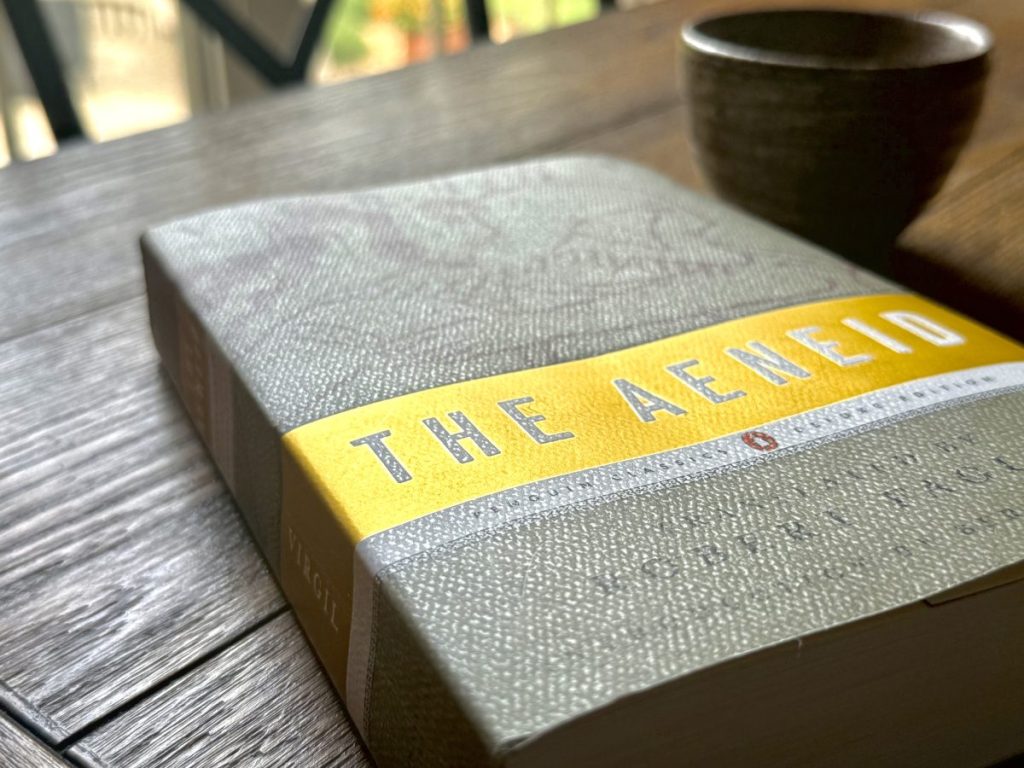
This is part of a series. To find the Table of Contents for this series start by clicking here.
There’s a moment at the opening of Book 5 that I keep returning to. Aeneas and his fleet have just cleared the harbor at Carthage, and as they pull away, they can see Dido’s funeral pyre glowing on the shore behind them. Nobody says much. Aeneas doesn’t say much. And that silence, that almost liturgical restraint, tells you everything about what Virgil is doing in these two books. Books 5 and 6 are not just the middle section of a long epic poem. They are a hinge. A passage. And they ask a reader to sit with grief, memory, duty, and death in ways I didn’t fully expect.
I was told by a friend that Book 5 is often treated as the “lesser” book, just the interlude between the emotional devastation of Dido’s death and the grand, awe-inspiring descent to the Underworld in Book 6. I’d push back on that.
Yes, Book 5 is structured around the funeral games held in honor of Aeneas’s father, Anchises. And yes, having read Homer, I recognized I was back in Book 23 of the Iliad watching Achilles organize the games after the death of Patroclus. Virgil is clearly in conversation with Homer here, and the echo is unmistakable. But here’s what’s worth slowing down for: the grief driving each set of games couldn’t be more different.
Achilles in Iliad 23 is raw. His grief is destabilizing, almost feral. It threatens to unravel him and everyone around him. Aeneas’s grief is something else entirely. It is ordered. It is generous. It is communal. When competitors fall short or lose, Aeneas still finds a way to honor them. Sergestus limps his battered ship into port after crashing on the rocks, and Aeneas doesn’t overlook him, he gives him a prize anyway. That detail stuck with me. It feels less like Homeric heroism and more like the Roman concept of pietas embodied in real time: a leader who holds the whole community together even in his own mourning.
Then, that same night, quietly and unexpectedly, the ghost of Anchises appears to Aeneas and commands him to seek him out in the Underworld. I couldn’t read that scene without thinking about Hamlet’s father’s ghost on the battlements. Shakespeare clearly had Virgil’s playbook open. The ghost who arrives at night to redirect the living toward an unwanted but necessary reckoning is one of literature’s great recurring moves, and Virgil may well be the one who formalized it.
If Book 5 is the hinge, Book 6 is the door swinging fully open, into the dark.
One structural observation I can’t shake: Virgil seems to be deliberately reversing Homer’s order. Homer gives us the Iliad (war, action, the heroic world) and then the Odyssey (wandering, homecoming, the journey through experience). In the first six books of The Aeneid, Virgil runs that in something closer to reverse: we get the wandering and the emotional odyssey first, and the echoes of war and martial destiny afterward. It’s an inversion that feels intentional, maybe Virgil is asking us to see the Homeric world through a different, later lens. Maybe, but then that’s why I carry this thought as I continue to read. More thoughts to carry, more weight to feel, slower reading to enjoy.
And nowhere is that more visible than in how he handles Hades. Homer’s Underworld, the one Odysseus glimpses in Book 11 of the Odyssey, is misty, vague, half-formed. The dead are shades who barely cohere. Virgil’s Underworld, by contrast, has a nearly civic logic to it. There are roads. There are categories. There is something almost bureaucratic in the organization of the dead. I found myself wondering whether that shift reflects the Roman civic imagination, or whether it echoes something even older, the Hebrew conception of Sheol, which also evolved from a vague gathering place of shadows into something with more moral and structural clarity. I haven’t fully resolved that comparison, but I’m not ready to let it go either.
What genuinely surprised me in Book 6, something I had not anticipated, is that Aeneas doesn’t only encounter the dead in the Underworld. He also sees the unborn: future generations waiting to enter the world. Rome’s great heroes, not yet born, visible to Aeneas in a kind of prophetic pageant. That addition is not Homeric. It is something Virgil invented, and I think it’s doing specific work: this is not just a descent to mourn the past. It is a descent to understand what the past requires of you. Learn from history, the scene seems to say or accept that you’ll repeat its tragedies on your own children and their children.
Before I close, I want to flag something I noticed earlier in the poem that Book 6 makes me want to revisit: the prophet Helenus in Book 3, who gives Aeneas detailed warnings about what lies ahead. His counsel was so specific, so urgent — I keep waiting for it to fully resurface. As Aeneas emerges from the Underworld, armed with prophecy and grief and the weight of a whole future Rome, I find myself asking: is Helenus’s voice still in there somewhere? Still shaping the choices being made? My earlier mention of Virgil’s “inversion”, and these thoughts on Helenus, feel like a continuing development of the lens Virgil as me as a reader to use; almost as if he is building me a symbolic progressive bifocal as a key to his epic.
Let’s grab a cup, find a comfortable chair, and turn some pages and see where Virgil guides our focus. A few more gatherings at this table before we place Virgil back on the shelf. Apparently, this is what Virgil does to a reader.

