This is Part 3 of a four-part series, a broad conversation about reading and what it does to us over time. No category, no prerequisites. All are welcome at this table. The Table of Contents for this series can be found here.
There is a book on my daughter’s shelf in Boston that I picked up almost by accident, a year before it turned out to matter.
It was Margaret Atwood’s The Penelopiad, her short and sly retelling of the Odyssey from Penelope’s side of the loom. I read it the way you read a book on someone else’s shelf, a little lazily, a little out of curiosity, mostly because it was there and I was there. I liked it. I set it down and moved on to whatever came next. I did not know, that year, that I was reading the Odyssey backward before I had ever read it forward.
A year later I finally sat down with Homer himself, the Fagles translation, and I moved through the poem the way you move through a familiar city. Then I came to Book 11, the descent to the underworld, the scene where the ghosts of the dead crowd around Odysseus for the chance to speak once more to the living. And there she was again. Not Penelope herself in that scene, but her voice, her patience, her long waiting, all of it standing just behind the lines the way a person stands just behind a door you are about to open. Atwood had already told me what waiting costs a woman left behind by an epic. Homer was writing the epic that left her behind. I felt the two books lean on each other across a year and a continent, and I sat there at my desk and thought, she handed me a key before I even knew there was a door.
That is the discovery I promised you at the end of Part 1, and it is, I think, the strangest and most useful thing that spreadsheet ever showed me. I do not read books in a straight line. None of us do, if we are honest about it. But when I started tracing the connections row by row, I found that my reading has a habit of scaffolding itself, of quietly preparing me for books I had not yet met, sometimes years in advance and without my permission.
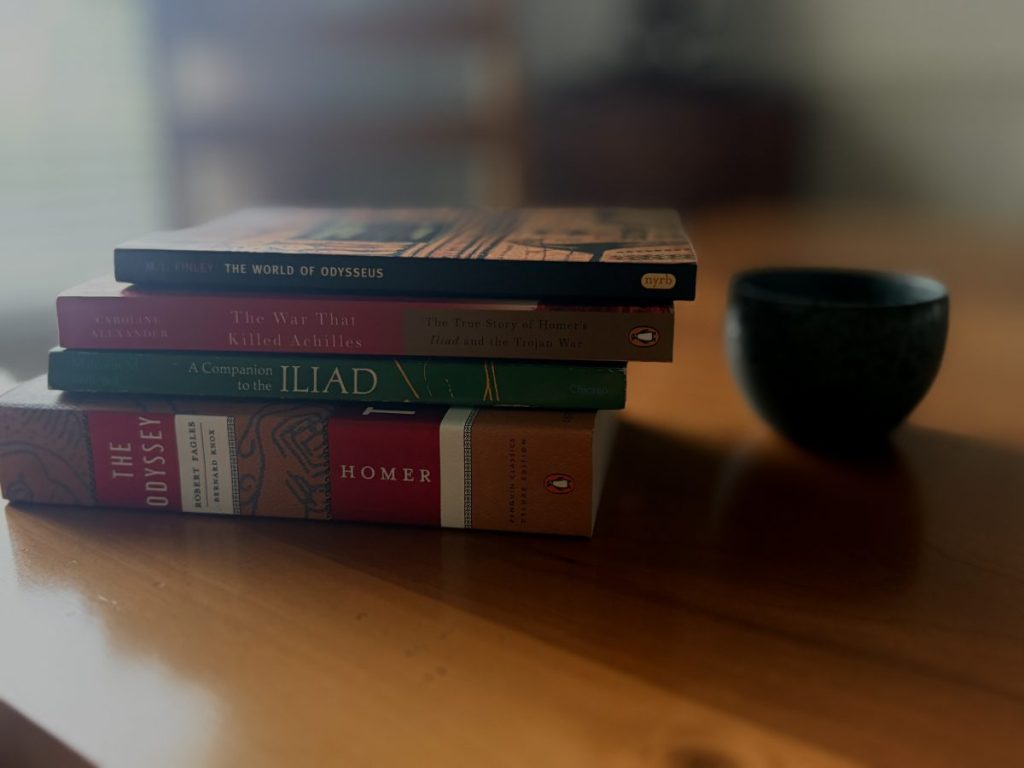
It is not only Atwood and Homer. When I finally took up the Iliad, I did not walk in cold. I had already spent time with Caroline Alexander’s The War That Killed Achilles, a book that walks a reader through the plain facts of the Trojan War before asking them to survive Homer’s version of it. And tucked even further back on my shelf, half forgotten, was Black Ships Before Troy, Rosemary Sutcliff’s retelling of the Iliad written for children. I am a grown man who spent thirty-six years in IT and five more teaching high school biology, and I will tell you plainly that a book meant for ten-year-olds gave me my first real feel for the shape of that war, the wrath of Achilles, the death of Hector, the old king kneeling before the man who killed his son. By the time I opened Homer’s actual lines, I already knew where the road went. I just needed Homer to show me why it mattered.
Right now, on my nightstand, this scaffolding is happening again, out in the open where I can watch it. I am reading M.I. Finley’s The World of Odysseus alongside the epics themselves, letting a historian’s account of Bronze Age custom and honor stand next to the poetry, each one making the other clearer. Neither book alone would do what the two of them do together.
And the scaffolding reaches further than epic poetry. In the middle of these same years, my reading in Hebrew scripture kept setting itself down next to Homer without my planning it that way. The descent to the dead in Book 11 of the Odyssey sat, in my mind, beside the strange and spare accounts of Sheol in the Hebrew Bible, two ancient peoples reaching for language to describe what none of us can see. I was not treating scripture as a text I studied on Tuesdays and Homer as a text I read for pleasure on Saturdays. They kept talking to each other, whether I meant for them to or not. I have come to believe that is simply how deep reading behaves, if you let it. The wall between your devotional reading and your recreational reading is thinner than it looks, and books on both sides of it keep passing notes.
Here is what I have come to believe about all of this, sitting with my spreadsheet and my nightstand stack. No book you read is ever wasted, even the ones you read too early, even the ones you barely remember, even the one from your daughter’s shelf that you picked up mostly because you were bored. Something in you keeps it. Something in you files it away and hands it back to you later, at exactly the moment you need a key and did not know there was a door.
I think this is genuinely good news for anyone who has ever felt behind. Maybe you never read the classics in the right order, or in any order at all. Maybe your shelf is a mess of half remembered titles and library sale paperbacks with no discernible plan. I want to gently suggest that the plan may already be working, quietly, underneath your notice, the same way mine was.
So, stop waiting to read the right books in the right order before you start. There is no right order. Pick up what is in front of you, the thing on your daughter’s shelf, the children’s version, the book that seems too simple or too far afield to matter. Read it anyway. You may be building a staircase you will not need for another year, and you will not know it is a staircase until the day you find yourself standing on it, looking down at a door you did not know was there.
Next time, I want to finally open the door I have been pointing at since Part 1, the book that never showed up in my export, the one that turns out to have been standing underneath all the others the whole time.

