
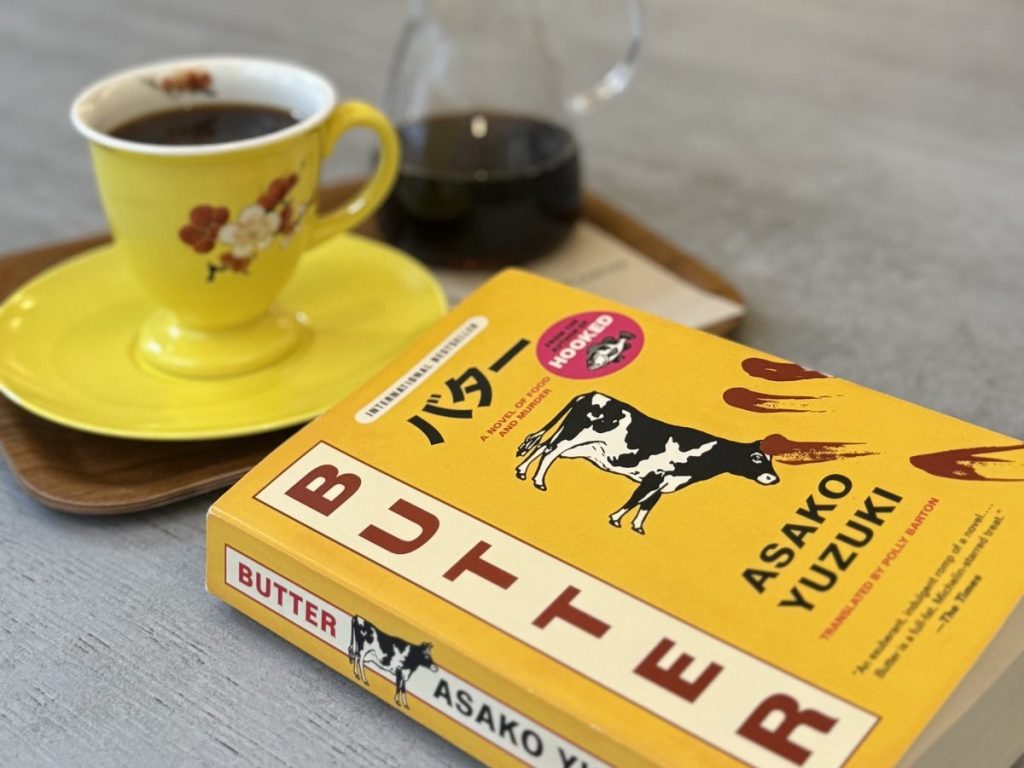
I didn’t expect a novel about butter to make me think so hard about hospitality, hunger, and how differently we read a room depending on where we grew up. But that’s exactly what happened with Asako Yuzuki’s Butter — my third Japanese author, and a book that snuck up on me in the best way.
It started, appropriately, in a coffee shop. A woman stopped at my table, recognized the cover, and told me she loved it, though she warned me it opens slowly. A few days later, a young man reading the same book confirmed it: slow start, and according to him, a slow ending too, something he said shows up often in Japanese fiction. I didn’t argue. If that’s simply a rhythm particular to Japanese storytelling, I’m content to let the pacing be the pacing and follow where it leads.
What pulled me in, honestly, was the food. I’ve always been curious about how a culture expresses itself through what it cooks and eats. I felt something similar reading Camilla Trinchieri’s Italian mysteries. Butter does this on a much sharper edge, its recipes aren’t garnish, they’re argument. Watching Rika fall under the spell of Manako Kajii’s cooking, inspired loosely by a real Japanese true-crime case, is really watching her fall under the spell of a woman who refuses to apologize for wanting things: food, pleasure, her own body.
That refusal is the real engine of the novel, and it’s where I had to sit with my own reaction as a reader outside the culture. The body-shaming running through this book isn’t a minor thread… critics and readers alike flag it as one of the most persistent, uncomfortable elements of the story, tied directly to real Japanese social attitudes toward women’s weight. My first instinct was to hesitate before recommending it to the women in my life, worried the theme might land as triggering rather than illuminating. But sitting with it longer, I think that instinct undersells the book. Several readers argue Butter isn’t endorsing that judgment… it’s staging it, deliberately, so it can be dismantled. Kajii’s refusal to feel guilty about appetite, in food or otherwise, is framed as the most defiant thing about her, not her crime. I still think a gentle heads-up is fair before handing someone this book. I just no longer think the heads-up needs to come with an apology.
The relationships underneath the food are just as loaded. Rika and Reiko spend the novel trying to help each other, and yet each of them is quietly carrying her own agenda into that friendship, a “secret goal” neither fully admits, even to herself. It’s a small, human kind of dishonesty, and I found myself recognizing it: how often do we tell ourselves we’re showing up for someone else when we’re actually working out something of our own? That tension doesn’t resolve neatly. It just keeps surfacing, in new relationships, in new configurations, right up through the end of the book.
Which brings me back to that slow ending. I think I finally understand why it felt that way to me, and it isn’t a flaw in the writing, it’s a difference in what counts as dramatic tension. Late in the novel, Rika notes that Japanese households often resist hosting gatherings at all, because the pressure to be a flawless host is so intense it becomes genuinely stressful. That’s not just a personality quirk; it echoes a real cultural value called omotenashi, a deeply rooted Japanese hospitality ideal in which a host anticipates every guest’s need in advance, down to invisible details, so nothing is ever asked for and nothing ever feels imperfect. It traces all the way back to the tea ceremony tradition. Against that backdrop, the final chapters, we witness Rika hosting in a half-furnished new home, friends improvising with mismatched utensils, an uninvited guest turning up at the last minute, everyone ultimately staying the night, aren’t “nothing happening.” They’re a direct, almost rebellious answer to that cultural pressure. For a Japanese reader steeped in the omotenashi ideal, that scene is quietly radical. For me, reading it as an outsider, it just looked like a nice dinner party running long.
That gap is the whole reason I read books like this. Not to master another culture, but to notice, in real time, the places where my instincts and someone else’s instincts diverge, and to sit in that gap a little longer than usual. Two strangers in two different coffee shops handed me a piece of that puzzle without knowing it. Butter handed me the rest.

