While spending a few weeks in Boston, I always keep a running list of things I want to do. After four years of making regular visits, I almost feel like a local. Some activities are reserved for those inevitable rainy New England days, and this happened to be one of them.
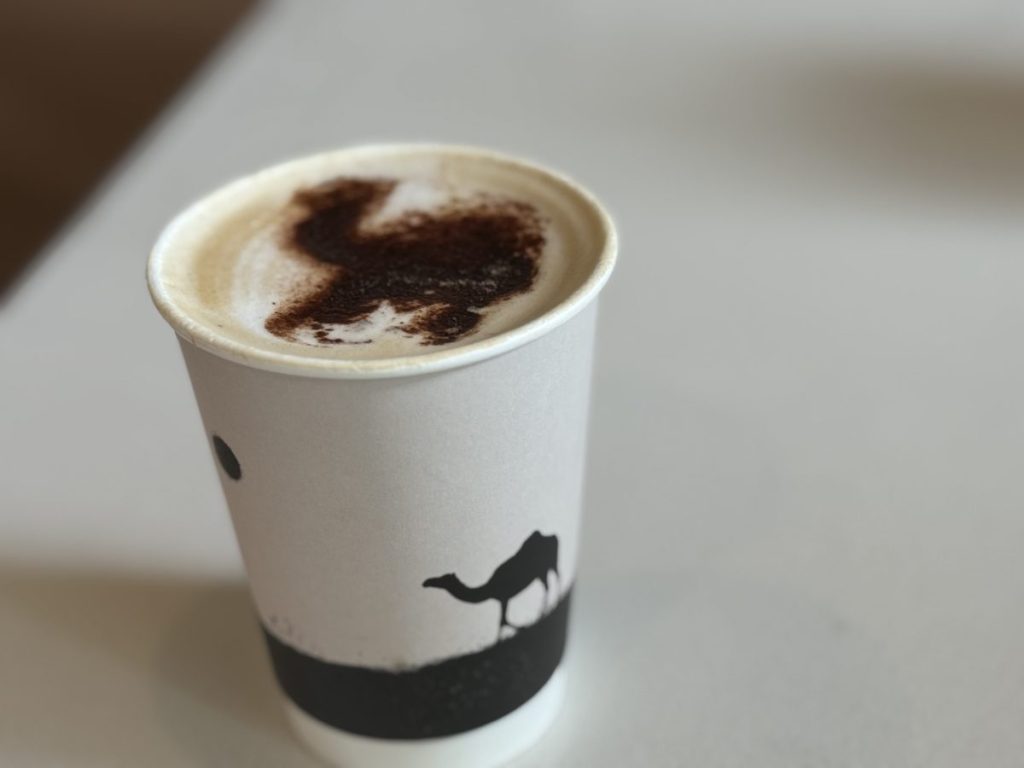
So, I headed over to the Coolidge Corner Theatre to see Rose of Nevada. Before the movie, however, I made what has become an equally important stop… Arwa Yemeni Coffee, over in Brookline. If you know me, you know I have a weakness for Yemeni coffee, second only to Ethiopian Yirgacheffe. After sitting with my Yemeni latte and reading, I opened my umbrella and walked over to the theater, curious about a film I knew almost nothing about.
I had first noticed Rose of Nevada only a few days earlier while attending a documentary on Mary Oliver. (I’ll share my thoughts on that film soon.) I didn’t return because it was raining; the weather only determined the day. Nor was I drawn by a cast of familiar names. I recognized Callum Turner but knew little about the rest of the cast or the director. What caught my attention was learning that the film had been shot on 16mm film and featured an intentionally distinctive sound design that created a vintage, almost dreamlike atmosphere. That alone was enough to convince me this was something worth experiencing.
Within the first few minutes I realized I wasn’t watching a typical Hollywood movie.
I hesitate to label it simply as an “Indie film” because that term often makes people think only of a smaller budget. This felt more like an art-house film, one that trusted cinematography, pacing, and atmosphere as much as dialogue. It wasn’t interested in dazzling me with visual effects or celebrity performances. Instead, it invited me to slow down and pay attention.
What struck me most was that much of the story was told through the camera rather than through words. The perspective shifted frequently, lingering on landscapes, faces, and quiet moments that felt more like carefully composed photographs than conventional movie scenes. The film seemed content to let silence, lighting, and composition do much of the storytelling. I found myself watching differently, not waiting for the next line of dialogue but looking for what the camera was trying to say.
The result was a film that felt less like entertainment in the usual sense and more like experiencing a piece of visual art.
Although the story unfolds in a fishing village, it could just as easily have been set in any small town whose identity has been shaped by a struggling industry. The setting becomes almost universal. It is really a story about people, families, and communities trying to hold on to one another while facing uncertain futures.
The science-fiction element introduces an event that reaches back into the past, but for me it never overshadowed the human story. As Liam (Callum Turner) and Nick (George MacKay) navigate their relationship and the choices before them, I found myself thinking less about the mechanics of the plot and more about the questions the film was asking.
In our culture we often celebrate pursuing our own dreams, achieving our own goals, and finding personal fulfillment. Those are not bad pursuits. Yet Rose of Nevada quietly asks another question that we don’t hear nearly as often: What do we owe the communities that have shaped us?
How far would I go if sacrificing one of my own ambitions meant strengthening, or perhaps even preserving, the people and place that gave me life? When does “my future” become less important than “our future”?
Those aren’t questions the film answers for us, nor should it. Good films rarely hand us conclusions. Instead, they leave us with questions worth carrying home. I found myself thinking about those questions long after the credits rolled.
If you have the opportunity to see Rose of Nevada, I encourage you to give it a chance. Just don’t expect a conventional Hollywood experience. It certainly wasn’t one for me, and that was precisely its appeal. It reminded me that there are filmmakers who are less interested in spectacle than in creating something thoughtful, beautiful, and quietly challenging.
More than anything, the afternoon reminded me why curiosity remains such a valuable companion. Every now and then it nudges us toward something we never would have chosen otherwise. This time it led me into a small neighborhood theater, a cup of exceptional coffee beforehand, and a film unlike any I had seen before. I’d call that a pretty good rainy day.

