
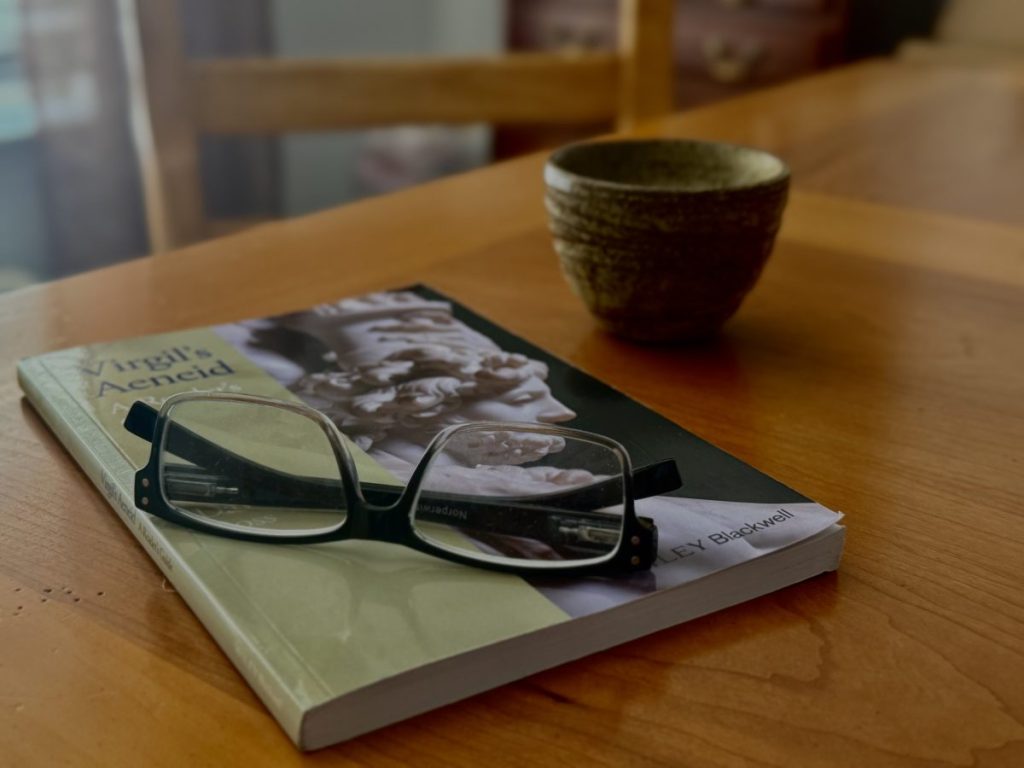
I’ve just closed The Aeneid, and unlike the quiet arrival I felt after Homer, this closing feels different. Less like stepping onto solid ground and more like standing at the edge of something, looking back at a long, uneven road. I want to be honest about that at the outset: I never felt as pulled into Virgil’s story as I did into Homer’s. Where the Iliad and Odyssey felt like adventures I was living inside, the Aeneid often felt more historic than immediate, more monument than tale. I say that not as a complaint but as an observation worth sitting with, because I think it tells me something about what Virgil was trying to do.
It took until Books 5 and 6 for that project to come into focus for me. Aeneas’s funeral games for his father, held in the shadow of Dido’s still-smoldering pyre, gave me my first real glimpse of what makes this hero different from Homer’s. His grief is ordered, generous, communal, pietas in motion rather than rage barely restrained. And then the descent into the Underworld in Book 6 showed me something Homer never attempted: a hero shown not just the dead but the unborn, the whole future of Rome laid out like a promise he now must carry. That is not a detour. That is Virgil declaring his purpose. This is a descent to learn what history requires of you, not merely to mourn what it took.
Books 7 and 8 might be Virgil at his best. The white sow on the riverbank, prophecy finally becoming address rather than abstraction, was one of the few moments the poem made me hold my breath. And then Juno reaching into the underworld for Allecto to light the fuse in Turnus reminded me that in this poem, the gods don’t so much cause catastrophe as find the fire already smoldering in a man and set a match to it. That is a genuinely uncomfortable theology, more honest, maybe, than it sounds at first, because it will not let the human off the hook.
What I keep returning to, though, is the structural shift I noticed early and watched confirmed all the way to the end. The first half of the Aeneid runs on the frequency of the Odyssey, wandering, storms, a hero displaced from home. The second half is Virgil writing his own Iliad, war, alliances, the register thickening into something martial and brutal. Homer gave the world war and then the long road home. Virgil reversed it, and I don’t think that reversal is incidental. It feels like Virgil asking a Roman reader to see Homer’s world through older, more knowing eyes, one that already understands the cost.
And that brings me to the ending, which is the part I have not been able to shake. Homer’s warriors, for all their fury, find some way back to a kind of dignity. Achilles returns Hector’s body to Priam. Odysseus comes home changed but whole. Virgil does not give Aeneas that grace. In the poem’s final lines, driven by a rage with no room left for mercy, Aeneas kills Turnus in a fury that looks exactly like the fury he is condemning. The founder of Rome exits the poem not looking clean, but looking, in that last terrible moment, like the very madness he was supposed to have carried past. Homer’s heroes resolve their war-like ways with something like respect intact. Virgil’s hero loses his grip on the one virtue, pietas, that was supposed to define him.
I think that is why this epic sits differently in me than Homer did. Homer gave me tenderness inside violence, grief that never cancelled out the humanity of the people feeling it. Virgil gave me a hero who carries everything, a father, household gods, a son, an entire civilization not yet born, and shows me that the carrying itself can eventually curdle into the very thing it was meant to prevent. Aeneas spends twelve books being told what history requires of him, and in the end he becomes proof that even a righteous burden, carried long enough under the wrong gods, can tip into madness.
Homer left me at a threshold, ready to walk into Virgil with borrowed aliveness. Virgil leaves me somewhere quieter and harder to name, less like arrival, more like a caution. Perhaps that is the more Roman ending after all: not triumph, but the sober recognition of what founding something on top of unrestrained anger costs, gods watching or not. I am glad I made the journey. I am not sure I am ready yet to say what it has done to me.
Yet, I close this chapter knowing the next one is already at the door. Dante is waiting, and I’m told he’s bringing Virgil back with him, this time as my escort rather than my author. My curiosity is already piqued.

