
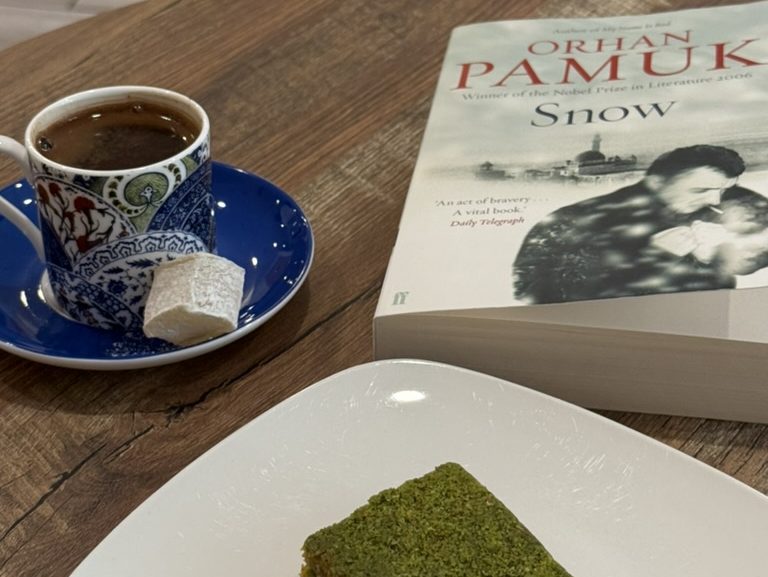
There are some novels that almost demand a particular kind of setting, as if the book itself is quietly suggesting how it would like to be read. Orhan Pamuk’s Snow has always felt that way to me. It’s a story of political tension, spiritual yearning, and deep inner stillness set in the snowbound city of Kars. And somehow, it seems to call for a small cup of Turkish coffee… dark, thick, and slightly mysterious, to sit beside it while you read.
Turkish coffee announces itself long before you take a sip. The slow preparation, the rising foam in the cezve, and the scent filling the room all insist that you pause and pay attention. There is no rushing it. The grounds must settle. The cup must be handled carefully. In the same way, Snow asks you to slow down, to sit with ambiguity and unresolved questions, to watch the snowfall on Kars not only as a backdrop but as a kind of character that drifts through the story, blanketing everything in a quiet, unsettling calm.
When you lift the tiny cup of Turkish coffee and take that first sip, the taste is direct and concentrated, almost startling. There’s no filter between you and the flavor. It’s strong, earthy, and unapologetically present. Pamuk’s narrative voice in Snow has a similar effect. He does not shield you from the complexity of his characters or the tensions that pull at them, between secularism and faith, art and politics, belonging and exile. You meet these questions in their full strength, without much dilution. You’re invited to sit with discomfort, much as you sit with the intensity of the coffee.
As you read, the snow in the novel keeps falling, layering streets, buildings, and people’s lives. It muffles sound and movement, creating a sense of isolation and introspection. Turkish coffee has its own kind of layering. Beneath the dark surface of the drink, the grounds wait silently, forming patterns that some cultures read like miniature maps of the future. After you finish the cup, the residue at the bottom is a visual echo of everything that has already passed your lips. It invites interpretation, reflection, even a little superstition. In Snow, Pamuk offers a similar invitation. He layers memories, political events, personal encounters, and moments of sudden, quiet beauty, and then asks the reader to make sense of the shapes they form.
There’s also a ritual to Turkish coffee that pairs well with Pamuk’s slower, patient storytelling. It’s not just about caffeine; it’s about hospitality, conversation, and the shared silence between people who may not fully understand each other but still sit together at the table. Snow is full of such moments, characters circling around one another, looking for connection, understanding, or simply a way through the storm of conflicting identities and beliefs. The coffee’s small cup feels almost symbolic: you don’t need a large quantity; you need something concentrated that lingers long after the last drop.
I find that reading Snow with a cup of Turkish coffee beside me changes the pace of my attention. The drink’s thickness slows each sip. You can’t gulp it down and move on. Its grainy texture and lingering taste ask you to linger as well, to stay with sentences, to let a scene rest in your mind for a moment before turning the page. The novel benefits from that kind of lingering. Pamuk’s snowbound city really comes alive when you give it time to breathe, when you let the continuing snowfall and the unfolding conversations sink in and settle, like coffee grounds in a cup.
And when you reach the end of the cup, there’s that familiar moment of decision: do I turn it over and read the patterns, or simply leave them where they are? Snow offers a similar choice when you reach its final pages. Do you try to parse every symbol, every political nuance, every religious question? Or do you accept that some of the story resists neat interpretation, leaving you with a feeling rather than a formula? In both the coffee and the novel, part of the experience lies in the unanswered questions, the things that remain obscure, half-lit, and still somehow meaningful.
So, if you’re curious about pairing your reading with your coffee, Snow and Turkish coffee make for a compelling afternoon. Prepare the coffee slowly, watch the foam rise, notice the scent that fills your kitchen or café. Then open the book and let Pamuk’s snowy world unfold at the same measured pace. Taste the bitterness and depth in the cup alongside the tension and beauty in the story. Let both leave a residue… grounds at the bottom of the porcelain, images and questions at the bottom of your thoughts, that you carry with you long after the snow has fallen and the coffee cup is empty.

