Most novels start when we open the cover and turn to that first page. But not this one. It started when the car went into park and we walked across the gravel parking lot.
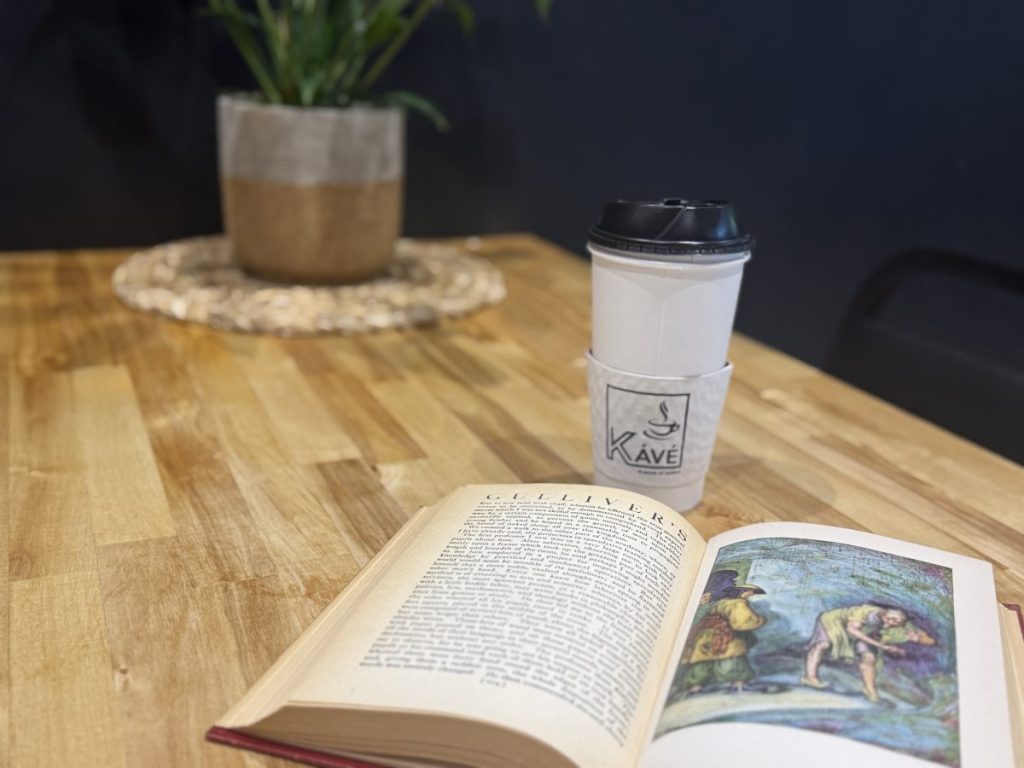
I found myself wandering through an antique mall in St. Louis, you know the kind, where the aisles are narrow and everything smells faintly like cedar and old paper and tucked in between some forgotten cookbooks and a stack of Life magazines, I found it. A 1941 edition of Gulliver’s Travels. Worn cover, beautiful in that imperfect way only old books can be. I paid a few dollars for it, tucked it under my arm, and figured it was time to finally read a book I had apparently been “supposed to” read in high school.
Better late than never, right?
I’ll be honest, I came in expecting a children’s adventure story about a guy who ends up tiny among giants. What I got was something entirely different. Jonathan Swift, writing back in 1726, wasn’t really writing a fantasy. He was writing a mirror. And what he saw reflected in that mirror? Well, it turns out it still fits rather uncomfortably today.
There’s a line in the book that stopped me cold. Swift writes that “poor nations are hungry, and rich nations are proud, and pride and hunger will ever be at variance.” I had to set the book down for a minute. Not because it was shocking, but because it was so plainly, quietly true. Here was a man writing three centuries ago, and he just… said it. No algorithms, no cable news cycle, no social media outrage. Just an observation. And it landed with the kind of weight that only simple truths carry.
I’m not bringing this up to draw some neat political conclusion, that’s not what this is. Honestly, I don’t think Swift was trying to do that either. I think he was doing what great writers do: naming something that already exists in the world and asking us to sit with it for a while.
And that’s what I found myself doing. Sitting with it.
The “pride” Swift describes feels familiar, that particular brand of confidence that can come with comfort and security, the sense that the way you do things is simply the way things are done. It’s not always mean-spirited. Sometimes it’s just… unexamined. And the “hunger” on the other side of that equation isn’t just about food. It’s about dignity, about belonging, about wanting a seat at a table that keeps getting moved. The tension between those two things is not a new story. That’s an old, old story.
What got me, reading this on my deck with a cup of coffee, was how alive this 300-year-old book felt. How Swift’s satirical little adventure story turned out to be one of the more honest pieces of writing I’ve encountered in a while. I didn’t expect to be genuinely moved by it. I expected to check a box.
I think that’s the thing about classics — and maybe why so many of us never go back to them after high school. We associate them with obligation, with being tested on themes and symbols we were supposed to identify. We forget that somebody sat down and wrote these, out of something they felt or noticed or couldn’t stop thinking about. When you find one that clicks, it’s a little like meeting someone at a party you assumed you’d have nothing in common with and ending up talking for two hours.
That 1941 copy sitting in an antique mall in St. Louis was someone’s book before it was mine, Marilyn Bloom signed on the inside cover. Who was she? Was she an English teacher who had students like me? Did she have her own children she shared this book with? I like thinking about who else may have read it since her. What was happening in 1941 when they cracked the spine? What line stopped them, too? Who placed this book here for me to find today?
I don’t have a tidy takeaway here. Just an invitation. If there’s a classic you never got around to, or one you read under duress in a classroom and never gave a fair chance, maybe pick it up again. Not for school. Not to be well-read at a dinner party. Just to see what a person from a completely different century was noticing about the world.
You might be surprised how close to home it lands. I was.
This may be our shared experience when we read a classic novel.

