Dunaway Books sits on Grand Boulevard in St. Louis, and it rewards a slow walk. My wife and I stumbled in on a weekend trip… Cardinals game, a cousin, the usual St. Louis itinerary — and I found myself standing in front of a shelf I wasn’t expecting. Not one Wizard of Oz book. Not two. A full shelf, spine after spine, each one a different title from the Land of Oz.
I flagged down one of the store managers. That’s when the story got interesting.
After L. Frank Baum published the original Wizard of Oz, children started writing him letters. Not fan mail exactly, but requests. Demands, almost. They wanted more Dorothy. More of the Scarecrow and the Tin Man. They knew the Wizard had floated out of Oz in a balloon, and they wanted to know when he was coming back down. Baum listened. Around 1908, he delivered The Land of Oz, then Ozma of Oz. The letters didn’t stop. Neither did Baum. By the time it was over, the series ran to 31 books.
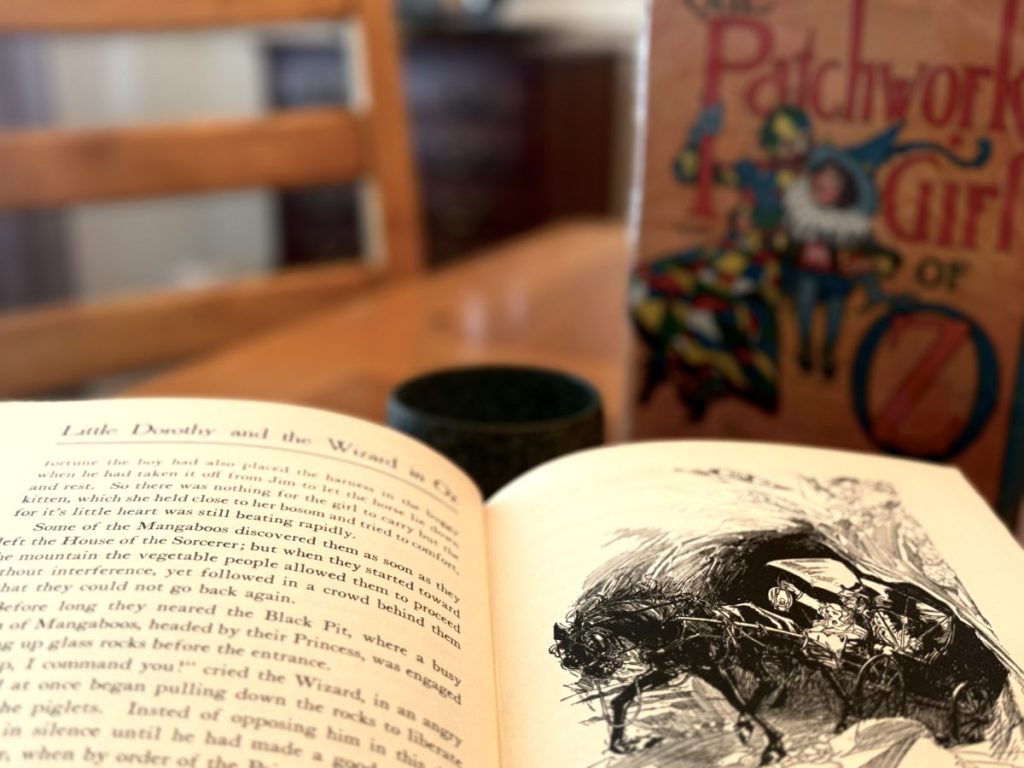
I left Dunaway with two of them — Dorothy and the Wizard in Oz (third in the series) and The Patchwork Girl of Oz (sixth). I hadn’t walked in looking for either one. That’s what a good bookstore does to you.
This is where a scholar named Jack Zipes comes in. I’d encountered him a few weeks earlier on a literary podcast during a walk — the kind of discovery you file away and then forget, until something makes it suddenly relevant. Zipes is a retired professor who spent his career arguing that fairy tales aren’t just entertainment. They do real work. His position: fairy tales “serve a meaningful social function, not just for compensation but for revelation, the worlds projected by the best of our fairy tales reveal the gaps between truth and falsehood in our immediate society.”
That’s a serious claim for a story about a girl and a tornado. But standing in front of that shelf at Dunaway, it didn’t feel like an overreach.
Think about what the Oz series actually is. It’s a world built on correspondence between an author and his readers. Children told Baum what they needed, and he wrote it into existence. The Wizard albeit a fraud, a man behind a curtain, became the character an entire generation refused to let go. They knew he’d escaped in a balloon. They were waiting for him to land. That’s not passive consumption. That’s a readership demanding accountability from a story.
Zipes would probably have something to say about that.
I read Dorothy and the Wizard in Oz first. It held up. The plotting moves fast, the world keeps expanding, and there’s a particular pleasure in watching Baum honor the children who pushed him to keep going. Reading it as an adult, you notice things you would have missed at eight years old. Like the way authority is consistently undermined, the way the smallest characters tend to be the most resourceful. The enchantment is still there. So is the argument underneath it.
Baum didn’t set out to write 31 books. He was pulled there by his readers. That’s a strange and wonderful way for a series to exist, demand-driven fantasy, shaped by what kids needed to believe was still possible. Zipes would call that revelation. I’d call it a pretty good reason to buy a book off a shelf in St. Louis.
Go find a fairy tale. The Oz books are a fine place to start. Dunaway Books, if you can get there may be even better.

