
Tranquility is defined as a state free from disturbance — calm. Wonderment is a state of awed admiration or respect. When is the last time we allowed ourselves to experience either of these, let alone both? And how does one even travel to those “states”? I want to suggest we can get there the same way I recently did — through poetry. Stay with me. The word poetry didn’t send you running for the exit, did it? Good. Here we go.
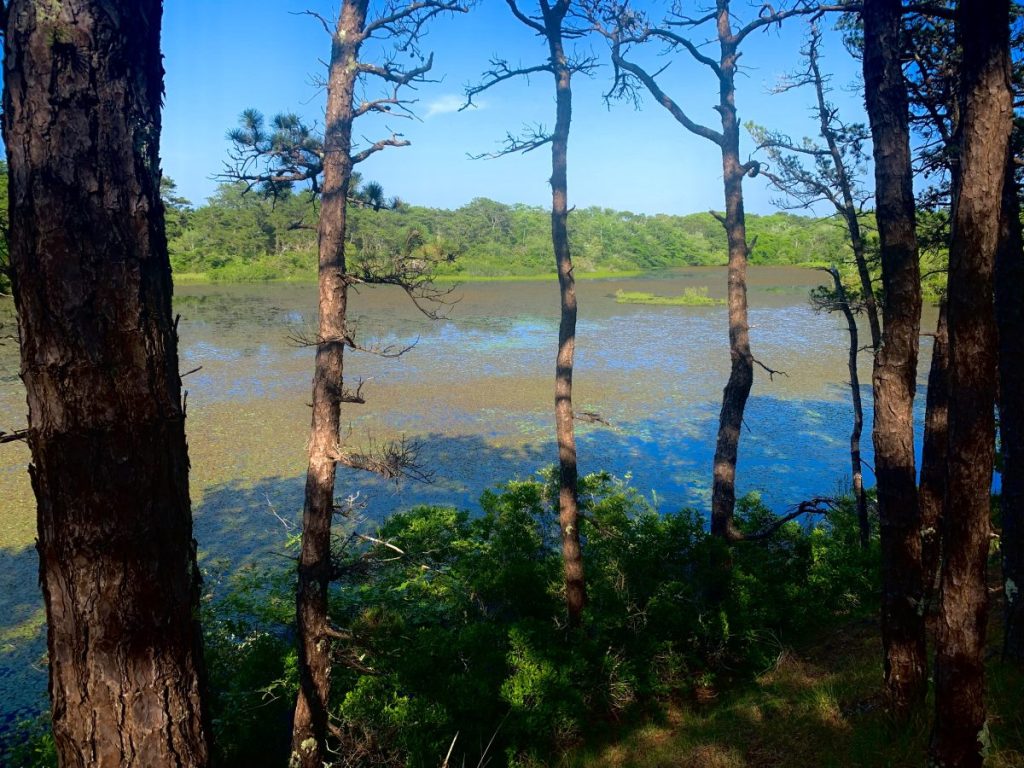
Sometime in the recent pass, as we were visiting in the Boston area, we rented a car and drove out to Cape Cod to spend a couple days. One morning we set out and drove to Provincetown, or P-town as some locals refer to it. It was a pleasant drive to the northern end of Cape Cod and the day was sunny and mild. We ventured into the Province Lands area of the Cape Cod National Seashore. In my hand I carried a collection of poems by Mary Oliver as I traversed a trail into the cool air of the pines. As I stopped along the trail at this pond, I opened the collection of poems, I had with me, Devotions, and turned to At Blackwater Pond, and how appropriate, the first line reads,
“At Blackwater Pond the tossed waters have settled/after a night of rain.” — Mary Oliver, “At Blackwater Pond,” from Devotions (Penguin Press, 2017)
and a shower had indeed passed through the night before.
I’ll let Oliver read the rest herself — the Beacon Press recording of her reading this poem aloud is linked here, and I’d ask you to listen before you read on.
I was first introduced to Mary Oliver’s poetry reading her book American Primitive. I have found reading Mary Oliver feels like walking beside someone who notices everything you usually miss. American Primitive, as well as her collection Devotions, are full of those small, vivid moments in nature that open into something deeper—something about wonder, solitude, and what it means to be alive. Had it not been for this poem, I would have very likely walked right on by this pond and never stopped and looked into that water, the water that Oliver had dipped her “cupped hands” one morning.
But if you are new to reading poetry, take comfort — you may not be as new to it as you think. If you have ever read the Psalms, you have read poetry. Consider these lines from Psalm 65:
They drop upon the pastures of the wilderness: and the little hills rejoice on every side. The pastures are clothed with flocks; the valleys also are covered over with corn; they shout for joy, they also sing.
As I read that, I can picture sitting on one of those hillsides, letting my eyes wander across the landscape with quiet awe. Poetry — whether ancient Hebrew scripture or modern verse — is a dense medium: fewer words, vast meanings. A good poet doesn’t fill everything in. They invite you to find your own path through the work.
That is exactly what Oliver does in At Blackwater Pond. Take the opening image: the tossed waters have settled after a night of rain. The tranquility we seek in life is often ushered in through the “tossed waters” of our daily experiences. When I approach poetry with that kind of openness — not trying to decode what the author meant but searching for what it stirs in me — I find that is where the real reading begins.
Wonder runs like a thread through this poem. Oliver’s language invites us to explore the world with a childlike curiosity, to marvel at the ordinary, to see the extraordinary in a still pond or the rustle of leaves. I’ll admit that childlike curiosity is something I have sometimes buried under the weight of years. The poem gently reminds me it’s still there — waiting.
It also reminds me to slow down. In a world filled with constant hustle, Oliver’s verses act as a quiet counter-voice, calling us back to the beauty of the present moment and the value of life’s humble gifts.
For me personally, this poem has become a doorway — much like the Psalms — into a deeper expression of gratitude and praise. Just as David used poetic language to capture his experience of God’s creation, I find I can use poems like Oliver’s to re-tune my senses, to reintroduce the sounds of language to enrich my own inner life and expressions of faith.
My two takeaways from sitting with this poem are simple: seek the childlike curiosity I have buried under my years and pay attention to the small wonders blurred by the pace of my living. Maybe, just maybe, that is where I will find the tranquility and wonderment I long for — and in so doing, enrich my soul.
Let’s find a pond to return to occasionally and ponder not only what we see on the surface, but consider what lies beneath that surface…
“oh what is that beautiful thing
that just happened?” (Oliver)

