
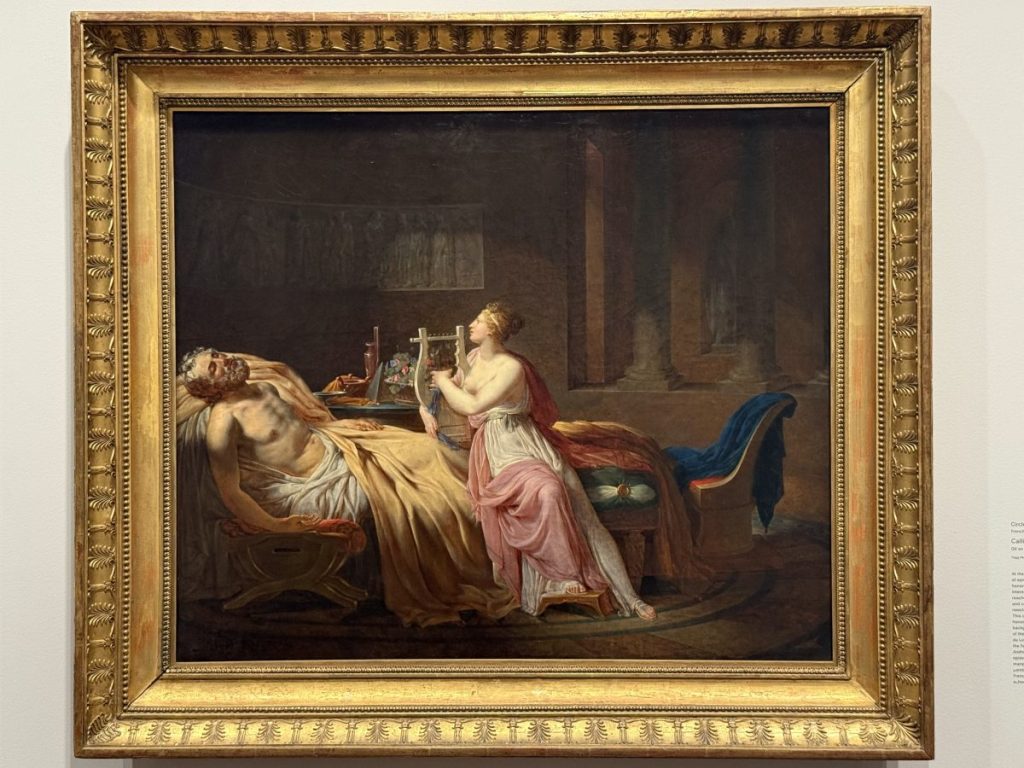
Circle of Jacques-Louis David, French, 1748–1825. Calliope Mourning Homer, 1812. Oil on canvas. Harvard Art Museums / Fogg Museum, Bequest of Grenville L. Winthrop, 1943.231. Personal photography.
This is part of a series. To find the Table of Contents for this series start by clicking here.
“Who are you? Where are you from? Your city? Your parents?”
Homer poses those questions near the very end of the Odyssey, almost as a final exam for the reader. And I have to be honest — after spending the last eight books with Odysseus in disguise, watching him absorb insults and stool-throws and worse, those questions hit differently than they would have at the opening of the poem. Because I’ve been asking them the whole way through, and I’m still not entirely sure I have the answers. But I think that’s the point. I think that’s Homer’s point.
Let me tell you what I saw in Books 17–24, and let me be upfront: I came into these final books wanting transformation. I was looking for it. Maybe too eagerly.
Odysseus arrives back on Ithaca as a beggar. He is kicked by the goatherd Melanthius and struck with a stool by the arrogant suitor Antinous. He does nothing. And I sat with that for a long moment, because this is the same man who couldn’t resist taunting the Cyclops as his ship pulled away — the act of ego that cost him years and cost his men their lives. That old Odysseus would have erupted. This one just absorbs it.
Then there’s Argos. His old dog, a puppy when he left, recognizes him through the disguise — and then dies. I found this one of the most quietly devastating moments in the whole poem. Is Homer telling us something tender here? That the Odysseus who left for Troy is truly gone, and Argos could only recognize the man he knew — not the man who returned? I think so. And I found myself both moved by it and slightly unsettled by what it implies.
Through Books 18 and 19, the pattern deepens. Telemachus, who was nearly paralyzed with helplessness in Book 1, now steps in when a suitor hurls a stool and sends everyone to bed — calmly, firmly, strategically. He is his father’s son in the best sense, practicing restraint not because he’s weak but because he understands timing. And Penelope — I started to see the seams in her steadfastness in Book 18. She tells the suitors, for the first time out loud, that Odysseus had instructed her to remarry once Telemachus grew. She’s not announcing a decision. She’s acknowledging that the threshold is near. Twenty years of holding, and Homer finally lets us see what that holding cost her.
Book 19 gave me the moment I wrestled with most. When the loyal nurse Eurycleia recognizes Odysseus by a scar on his leg, he grabs her and threatens to kill her if she speaks. She has been nothing but faithful. And his response is cold and absolute. I wrote in my notes: “This is not the impulsive hero of Troy. This is a man who will sacrifice anything — even gratitude — to reclaim what is his.” That should feel like transformation. And it does. But it also made me squirm a little, because the ruthlessness here doesn’t feel like the absence of the old Odysseus so much as a refinement of the worst of him. I kept asking: is this a new man, or just a smarter version of the old one?
Book 21 settled something for me. When Penelope brings out the great bow and announces the contest, every suitor fails to even string it. They warm it, grease it, strain — nothing. Then the beggar asks to try. They mock him. And Odysseus strings it with the ease of a musician plucking a lyre and sends an arrow through all twelve axes.
This is the moment I felt Homer answer the question I had been asking. The transformation has not erased the man — it has refined him. The warrior’s competence remains. What is gone is the recklessness, the ego, the impulsive need to be seen as Odysseus. He was willing to be a beggar for as long as it took. That’s not the man who shouted his name at the Cyclops.
And then, Book 22. I’m not going to pretend this was easy to read.
Odysseus kills Antinous first — an arrow through the throat while he’s mid-drink — and when the remaining suitors beg for mercy and offer to repay everything they’ve taken, he refuses. He and Telemachus and two loyal herdsmen slaughter every suitor in the hall. And then the maids who had sided with the suitors are hanged.
I wrote in my notes that I wanted to give that last detail exactly one sentence — and end it with a question mark. So here it is: The disloyal maids are hanged in the courtyard, and Homer records it without flinching — but should we?
I’ll come back to that question in a later post. For now, I’ll say this: I think the massacre is meant to feel both just and excessive simultaneously, and I suspect that discomfort is intentional. The ancient Greek concept of honor — of what had been taken from Odysseus, his household, his wife’s dignity, his son’s inheritance — is simply not the same framework I bring to the text. I had to keep reminding myself of that. Retributive and restorative justice are genuinely different things, and Homer is writing from inside a world where one was almost universally assumed.
Here is where my notes got the most tender, and I think it’s because Book 23 earned it.
Odysseus has slaughtered the suitors. The old nurse rushes upstairs to tell Penelope her husband has returned. And what does Penelope do? She tests him. She doesn’t embrace him, doesn’t weep immediately. She tells a servant to move the bed Odysseus built — a bed rooted to the floor, carved from a living olive tree, immovable. Only Odysseus would know it cannot be moved. He reacts with shock and emotion, and that is when Penelope yields.
This is not the woman who wept helplessly in the early books. This is a woman who has spent twenty years guarding her heart so carefully that she will not surrender it without proof — not even to the man she’s been hoping for. She has become his equal in patience, cunning, and self-possession. The marriage bed, rooted and immovable, is Homer’s symbol: the bond between them has weathered everything and it holds. That test reveals her transformation more clearly than anything else in the poem.
I came into Book 24 expecting more blood. Instead, Homer gave me something I didn’t see coming: mercy from above.
When the families of the slain suitors march on Odysseus seeking vengeance, Athena — on Zeus’s orders — intervenes and brokers a truce. Laertes, Odysseus’s aging father, is renewed in strength and kills Eupithes with a spear. One casualty. And then Athena commands the fighting to stop. And Odysseus obeys immediately.
That is the moment I felt most convinced. The man who once raged uncontrollably, who couldn’t resist one last triumphant shout at the Cyclops, now yields — immediately, completely — to the voice of divine wisdom. He doesn’t push for more. He doesn’t need to prove anything further. The transformation is complete, and it is completed not by his will alone but by something larger choosing mercy.
Athena makes the Ithacans forget the massacre. Odysseus is recognized as their rightful king. Peace returns to the island.
So let me answer Homer’s question the best I can: Who are you? The man who left for Troy twenty years ago left carrying the momentum of war — cunning, impulsive, glory-hungry, and untethered. Twenty years of shipwrecks, monsters, loss, and longing ground all of that down into something slower and harder and, I think, better. He came home to a wife who had become his equal in wisdom and patience, and to gods who — at the very end — chose peace over the continuation of blood. That movement, from the trauma of Troy to the mercy of Olympus to the quiet of a bed rooted in olive wood, is as complete an arc as I have ever read. It isn’t a simple arc, and I don’t think Homer intended it to be. There are moments — the nurse’s threat, the hanging of the maids, the refusal of ransom — where I squirmed and kept reading anyway. But that discomfort is part of the journey. The man who left for Troy was forged in fire. The man who finally sleeps beside Penelope was forged in something longer and harder than fire. I’d love to know if you feel the same way — or where you pushed back.
But before we push back too hard — there’s one more way to experience this story. Not a time machine exactly, but close: a cinematic one.
So, excuse me if you will, I have a movie ticket to buy. Christopher Nolan — yes, that Christopher Nolan, the director behind Inception and Oppenheimer — is bringing the Odyssey to the big screen this summer, and after living inside this poem for the past several weeks, I cannot wait to see what twenty years of wandering looks like when it finally fills a theater screen.

