
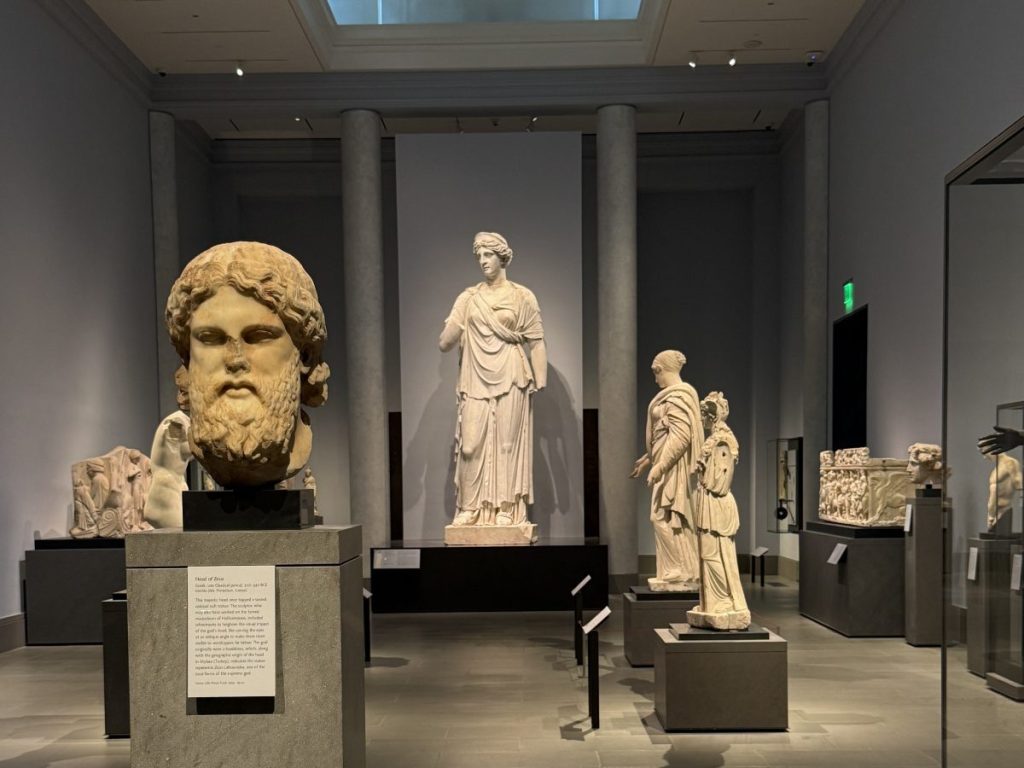
Personal photography. Museum of Fine Arts, Boston. Greek and Roman Galleries.
This is part of a series. To find the Table of Contents for this series start by clicking here.
So, what did I carry into Book 13?
A tension of how faithfulness in a marriage may have been viewed in the Bronze Age, but deeper maybe was the challenge to change our own thinking in the face of revelation. A willingness to listen and not just hear, that’s the path to understanding. However, I need to keep those thoughts slightly at bay, not dismissed, so that I listen closely to Homer then, and draw him out of the remaining books. I want this transformation to continue in my own mind, in my own time. Where is Homer headed with this epic?
And now the wandering ends. Odysseus steps ashore at Ithaca. But Homer doesn’t give us a triumphal march — he gives us something far more interesting.
When Athena finally lifts the mist and Odysseus realizes he is standing on Ithaca, his first act is to drop to his knees and kiss the earth, whispering that he “never thought to see all this again.” That is not the posture of a hero arriving to claim his throne. That is a man who has been broken down to something more honest than pride.
What follows only deepens it. Athena appears to him first as a shepherd — and he doesn’t recognize her. His perception is being tampered with, quietly reminding him (and us) that even his famous cleverness has its limits.
Must I always resist my perception to be “tampered with”?
She then obscures his vision entirely, then restores it, and finally alters his appearance so that not even his own islanders will know him. Do we sometimes fear a “changed” perception only because of our concern of what those who know us may think? Odysseus cannot see clearly; then others cannot see him. Homer has placed the great Odysseus in a posture of complete dependence — not on his reputation, not on his cunning, but on Athena’s timing and plan. That is where the inner shift can begin. He will succeed now not by asserting status, but by concealing himself until the appointed moment.
And me? … And you?
The disguise is both mask and training ground. By acting like a nobody, he must live like a nobody for a while — and that, for Odysseus, is genuinely new.
As the story moves on we find Odysseus in one of the most quietly powerful scenes in the entire epic. He sits in the hut of Eumaeus, his own loyal swineherd, and listens while Eumaeus praises the lost “Odysseus” as the finest master he ever served. And Odysseus — the man himself — sits there, unknown, in a lower social position than his own servant, and says nothing. Humility, maybe not enjoyed, but certainly allowing the “scene” to be a teacher. I could probably stand a scene or two like that in my life.
And Eumaeus demonstrates this in the midst of no evidence that Odysseus is even alive!
The elaborate false story he tells Eumaeus about himself — a tale of a wandering Egyptian — is revealing, too. In this made-up past, the fictional “him” must humble himself to survive. Maybe Homer is showing us an Odysseus who has come to doubt reckless glory-seeking and is learning to respect humility. The lie, in a way, tells a deeper truth about where he is headed. Subtle nudges occurring?
And then there is Eumaeus himself. He feeds a stranger, cares for a household that has been mostly forgotten, stays faithful to an absent master for twenty years — all without any reward or recognition in sight.
Would I have the strength to display a faith like that?
Odysseus watches this up close. Eumaeus embodies the very humility, piety, and steady goodness that Odysseus is only beginning to grow into. Homer places a mirror in front of his hero and lets him sit with it a while. May we slide over in front of that same mirror?
The transformation in these books isn’t Odysseus’s alone. Later we see something quiet is shifting in Telemachus as well. He obeys Athena quickly when she nudges him to leave Sparta, forgoing the honor-feast at Nestor’s palace to protect what matters at home. When a fugitive seer named Theoclymenus begs passage on his ship, Telemachus says yes — and then, when they arrive in Ithaca and Theoclymenus needs lodging, the young prince honestly admits: “My house is overrun; I can’t host you as I ought.” He doesn’t pretend otherwise. He finds another arrangement.
That is a small moment, easy to miss. But it’s a prince admitting a limit. It’s a young man choosing realistic kindness over the performance of status. And Book 15 ends with Telemachus walking not to his own house — but to the swineherd’s hut. A prince going to the lowest rung of his household to find his footing. Homer doesn’t make a speech of it. He just lets it happen.
In this last book for this post, Book 16, is where the threads begin to pull together, and it offers us perhaps the most unexpected image of transformation in these four books: a young man under enormous pressure, with an ambush behind him and a houseful of enemies ahead, pausing to make sure an old beggar is clothed, fed, and cared for. Telemachus doesn’t announce his virtue — he just folds the stranger into his plans, even asking Eumaeus to see to the old man if Telemachus himself is killed by the suitors’ plot.
That is the image I keep coming back to.
Being humble doesn’t always show itself in humility — it often begins with a gentle nudge of a change in the heart that manifests itself in hospitality. An ever so gentle transformation in a prideful person.
When Athena restores Odysseus’s true appearance and he stands before Telemachus in youthful splendor, the son’s first instinct is awe — he assumes this must be a god and offers golden gifts. When Odysseus says, “I am your father,” Telemachus can’t take it in at first. And then the truth lands, and he weeps. Not with rage. Not with a warrior’s cry of “Now we’ll show them.” With tears, and an embrace. The son who grew up in the shadow of an impossible legend meets his father as a man, and something in him bends — away from the need to save everything himself, toward a willingness to take his place under his father and the gods’ plan.
Transformation here is not loud. It doesn’t announce itself. It shows up in who makes room for the vulnerable when they are under strain — and in the quiet willingness to receive what we were not sure we would ever see again. And this is what I want to settle into my soul like a pebble in sand, would you give it some space as well?
The next time we meet, I’ll be carrying what I find in the final books of The Odyssey — the long-awaited reckoning, the bow that only one man can string, and whatever Homer decides to say about what homecoming truly costs. I hope you’ll come back for it. Could this really go where I think it may? These four books of Homer showing us humility and disguise in a warrior’s warrior, and a son weeping in his father’s arms, should drive us forward in this epic to receive what Homer so faithfully will deliver for us. See you back at this table soon.

