
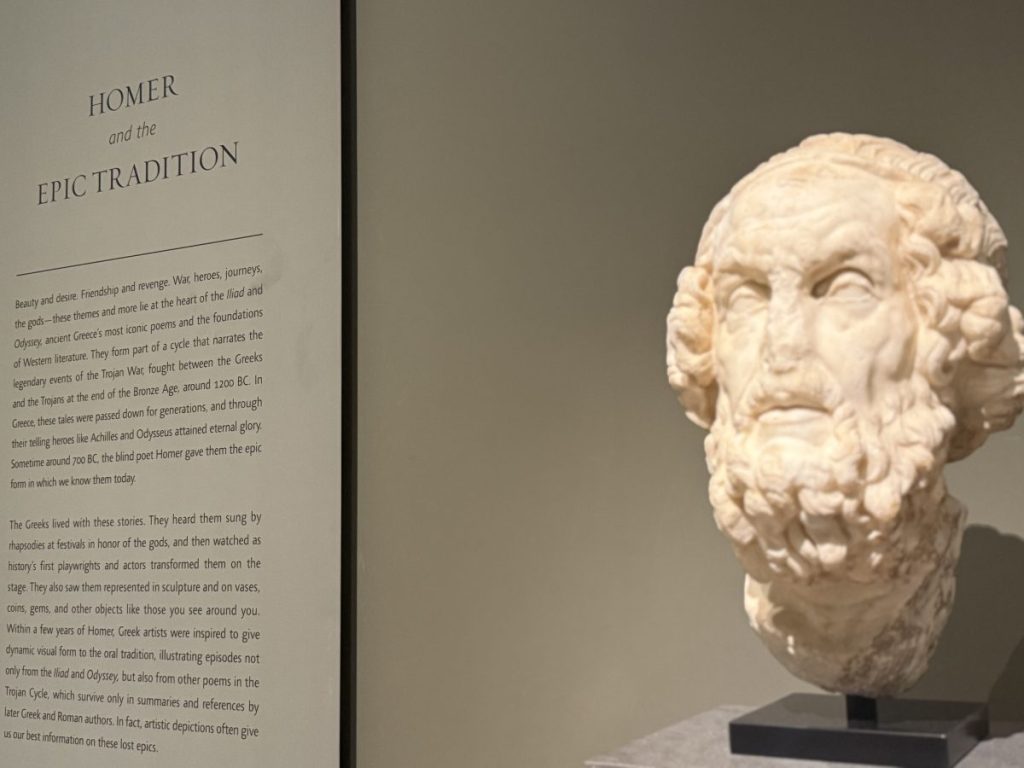
Personal photography. Museum of Fine Arts, Boston. Gallery 215A — Homer and the Epic Tradition.
This is part of a series. To find the Table of Contents for this series start by clicking here.
The saying goes, “You can never go home again.” I’ve been thinking that’s only half the trouble. You don’t have to leave for home to disappear — it changes while you’re standing in it, and so do you. The neighborhood shifts. The people who once filled your days grow older or move on. And the version of yourself who used to fit inside those rooms like a hand in a glove? She’s been quietly changing too, one ordinary day at a time. We like to imagine transformation as something dramatic, sudden, obvious. But most of the time it’s subtle and ongoing, a kind of slow-motion transformation that only becomes visible when we look back and realize, with a little shock: I’m not who I was, and this isn’t the home I remember.
On the surface, Books 1–4 of The Odyssey seem to be about a father who hasn’t come home and a son waiting for him. Odysseus is somewhere out on the wine-dark sea, and Telemachus is still in Ithaca, still in his father’s house, technically “home.” Yet his world has come undone around him. Suitors have overrun the palace, eating his food, courting his mother, and laughing in the very halls that once belonged to his family. Telemachus is stuck in place, but home has already gone on without him. These first four books — what scholars call the Telemachy, the story of the son — are easy to read as prologue, as mere setup for Odysseus’s grander return. But I kept lingering there, because Homer is doing something quieter and more interesting than I first expected.
Underneath the surface, what Homer is really asking is: what is home, anyway? And his answer, I think, is not what we might expect.
Home, for Homer, is not the building in Ithaca. It is something closer to order — a set of relationships, loyalties, and responsibilities that hold a family and a community together.
That sentence stopped me cold when it crystallized. The palace is still standing. Penelope is still there. The hearth is still lit. But home, in Homer’s sense, is in shambles — because the order that gave the place its meaning has been broken. The suitors are not just rude houseguests; they are a violation of every bond that makes a household a household. Hospitality has been twisted into exploitation. Loyalty has been replaced by scheming. And the young man who should be stepping into his father’s role is paralyzed, not quite a boy and not yet a man, unsure of his own authority in a house that bears his name.
It’s only when Athena nudges Telemachus out the door — to Pylos, to Sparta, to conversations with men who knew his father — that something in him begins to shift. The journey doesn’t just help him search for Odysseus; it helps him find himself. A different Telemachus comes back than the anxious, uncertain boy who first sat among the suitors and could barely raise his voice. By the time he returns, both he and Ithaca have changed so much that “going home” is less about reclaiming the past and more about stepping into a new, demanding present.
That is transformation — not a single dramatic moment, but a slow accumulation of small choices and difficult conversations, until one day you realize you are standing differently in the same room.
Where I stand in all of this is probably where a lot of us stand at some point in our lives. At 67, I’ve had several seasons that felt exactly like the Telemachy — periods when the “home” I thought I knew had quietly rearranged itself around me while I was busy living in it. Becoming a father was one of them. I worried I wasn’t ready, that I hadn’t changed enough to be equal to it. But I had been changing all along; the moment just made it visible. The wife who made me a husband encouraged me I was ready to be a father. Then that first daughter who was born drew out of me those changes as I cared for her, allowing me to see who I had become.
Homer, I think, understood that the most important journeys are not always the ones that take us farthest from home. Sometimes the most transformative journey is the one that finally shows us what home has always been made of — not walls and rooftops, but the loves and loyalties and responsibilities we carry inside us wherever we go. Homer may yet again be reaching through time and pointing us to the importance of family and friends. Asking us to focus on what is at the center of our social relationships and why they are so important to us.
And that, it turns out, is the invitation Homer has been building toward all along.
So, if questions like that tug at you, I’d love to invite you to read The Odyssey with me — not as an assignment, but as a companion on the road. Picture a small café table, two cups of something warm, a well-thumbed paperback between us. We could talk about Telemachus and his awkward, hard-won courage — and about our own unfolding becoming. Because if none of us can ever really go “back” home, maybe the truest thing we can do is sit together for a while and tell the truth about who we’re becoming.

