
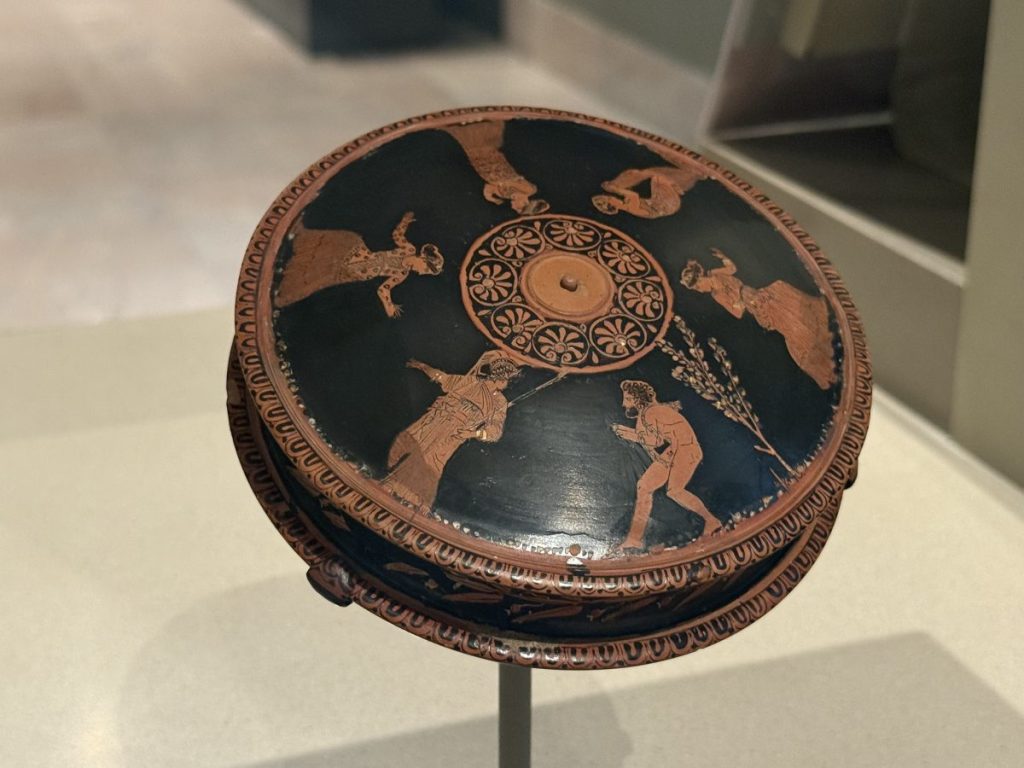
Aison, Greek (Athens), Classical period, about 420 BC. Cosmetics container (pyxis) depicting the meeting of Odysseus and Nausikaa. Ceramic, red-figure technique. Museum of Fine Arts, Boston. Accession 04.18a-b. Personal photography.
This is part of a series. To find the Table of Contents for this series start by clicking here.
In my last post, we sat with Telemachus at the edge of his own life and watched him do something small but radical: he left. He stepped out of a house that no longer felt like a house, climbed aboard a ship, and sailed off in search of a father he barely knew and a self he had never really met. His journey was our doorway into The Odyssey—change as something slow and ordinary, the kind you only notice when you look back and realize, with a little shock, that you no longer fit where you used to stand. Today, let’s grab another cup of java and slide up to the table.
Now, in Books 5–8, the poem finally lets us see the man Telemachus has been chasing all this time. We don’t meet Odysseus striding up the hill to his front door; we meet him on a distant island, sitting on the shore and weeping as he stares toward a home he hasn’t seen in years. Around him is everything a story might call “happily ever after”: a beautiful goddess named Calypso, a lush landscape, food, comfort, even an offer of immortality if he will stay as her husband. One may be tempted to think the choice is easy lest we forget he has a wife, family, friends … and a home. Where has that faded to? There’s an old saying that absence makes the heart grow fonder, has war eroded that very element in our hero?
That picture feels uncomfortably close to real life. I’ve known seasons where the outside looked pretty good—work that sounded impressive, routines that made sense, a role I knew how to play—and yet some inner part of me kept wandering down to the water’s edge, restless. Maybe you know that feeling: you’ve built a life that checks all the boxes, and still there’s this low, steady ache that says, “This isn’t quite it.” Calypso’s island is beautiful, but it is not his place. Her love, if you can call it that, comes bundled with captivity. Staying would be easier than leaving, but it would mean slowly becoming a stranger to himself.
Of course, leaving something that looks easy rarely feels easy at all. When the gods finally send Hermes to tell Calypso it’s time to let Odysseus go, she doesn’t give him a warship and a crew. She hands him an axe and some tools. He must cut down his own trees, build his own raft, lash it together with his own rope. Then he shoves off into open water—and almost immediately runs into the full force of Poseidon’s anger. The sea rises up, smashes his little craft, hurls him into the deep. For a while he is nothing more than a man clinging to bits of timber, coughing up salt water, hoping the next wave doesn’t finish the job.
I recognize that part too. There have been moments in my sixty‑odd years when I finally walked away from a situation that wasn’t right for me—work that had become a cage, expectations that no longer fit, versions of faith or family life that were quietly crushing me—and instead of feeling triumphant, I felt wrecked. From the outside, it may have looked like a brave decision. From the inside, it felt like hanging onto driftwood after a storm and wondering what, if anything, would be left of me when I washed up somewhere else. The easier-looking life was behind me. The truer life wasn’t visible yet. All I had was that deep, stubborn longing not to stay where I didn’t belong.
When Odysseus finally staggers ashore on the island of the Phaeacians, the story offers him a different kind of temptation. This time there is no jealous goddess holding him hostage. There is a young princess, Nausicaa, who finds him half-naked and bruised in the reeds and responds, not with fear, but with practical kindness—clothes, food, instructions. Her parents welcome him into a court that is safe, orderly, and genuinely hospitable. They admire him. They listen to his story. They offer gifts and the promise of a ship to carry him wherever he wants to go. It would be very easy to imagine Odysseus staying there, easing into a life that is comfortable and honorable and much less complicated than the mess waiting for him back in Ithaca.
Unlike Calypso’s island, Phaeacia isn’t a trap. It’s good. And in my experience, that might be the more subtle danger. Many of us live in Phaeacia seasons—a good job, a good community, a good enough sense of who we are. In my case, those seasons have felt like being wrapped in a soft, borrowed sweater: cozy, comforting, and just slightly the wrong size. That friend who reminds you that you had prepared for that job change, to retire from that career, and go teach as a gentle path towards retirement. That plan went from uncomfortable to excitement.
I’ve had workplaces, churches, and friendships that gathered me in when I was exhausted and unsure, places that let me rest and remember I was more than my latest crisis. And still, underneath the gratitude, there was a quiet awareness that I was only passing through, that this chapter was healing me for something I hadn’t quite reached yet.
Under all of this runs a single thread: Odysseus’ longing for home. The Greeks had a word for this—nostos, homecoming or a returning to one’s native land—and I love that the Greeks thought this longing mattered enough to give it a name and an epic; it makes me feel a little less odd for how fiercely I still miss places and seasons I can’t quite get back to. Like still playing cards with friends, who have been playing cards for over 40 years. While we’re aging and life changes accumulate, those foundational memories still support us with each hand dealt. For Odyseus, no matter how pleasant the island or generous the hosts, his heart keeps swinging back toward one particular set of shores: rocky, ordinary, full of trouble and unfinished business, but his. He is not chasing glory by this point. He is chasing belonging. He wants the wife who can grow old, not the goddess who never will. He wants the son who has had to grow up without him. He wants the everyday, humdrum life that is actually his own.
In the first part of The Odyssey, Telemachus had to find the courage to leave a broken home and step into a world that would change him. In this middle stretch, his father has to find the courage not to stay in the easier places that offer to keep him from ever facing home at all. One story asks, “Who will I become if I go?” The other asks, “Who will I become if I don’t go back?” Somewhere between those two questions, most of us are still walking. This could keep us at the table for a second, or even a third cup …

