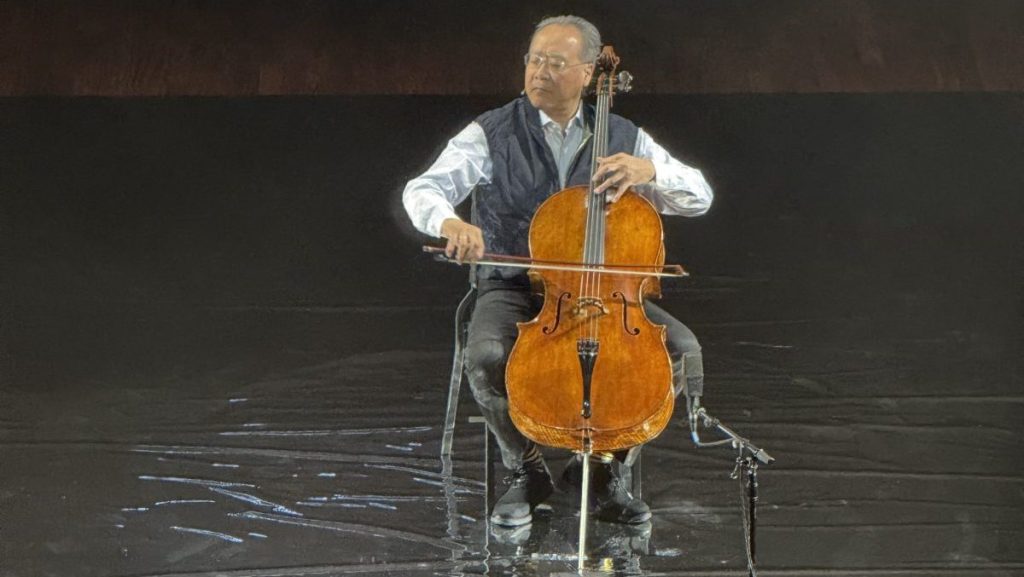
I recently attended a performance at the Grand Ole Opry House in Nashville, Tennessee, the newer venue built on the former Opryland park site and opened on March 16, 1974. That date marked the first Grand Ole Opry show held outside the Ryman Auditorium; the final Opry performance at the Ryman had taken place just one day earlier, on March 15, 1974. But this was a Sunday night and there was no Grand Ole Opry performing. So, what drew me there that night?
A cellist, a world-renowned cellist, by the name of Yo-Yo Ma.
If you’re not familiar with this gentleman, Yo-Yo Ma was born in France to Chinese parents. At age seven, he and his parents moved from Paris to New York City here in America. As Yo-Yo Ma put it, he came to a land of great opportunity having left grey molded cheese for square cheese slices wrapped in plastic, and fresh baked baguettes for sliced Wonder bread in a plastic bag. The man has a witty sense of humor in addition to being a master of his craft.
I was truly looking forward to this performance as I had just seen him in Boston about a month earlier. The two events were as juxtaposed as were the venues I was attending them in. For example, in Boston I took a 5-minute subway ride followed by a 5-minute stroll to reach my seat. In Nashville? Well, it began with a 15-minute drive down a busy Sunday afternoon interstate, followed by trying to find a place to park my 2 tons of metal and plastic that got me here, then walk across a very congested parking lot, while all the while knowing that the return trip would take quite a bit longer, and greater frustration, navigating the “after show” exit from the parking lot.
Second, the performances were different, yet similar in their own way. At an An Evening with Yo‑Yo Ma, the event in Nashville, his presence filled the stage in a way that felt both intimate and expansive. Alone on the stage with a chair and his cello, he spoke more directly through his playing and his brief remarks, drawing the audience into the narrative of each piece. In contrast, in Boston, he performed with The Interlochen Arts Academy Orchestra, a full orchestra setting, and his energy was not diminished; it was simply shifted. He became one voice within a larger musical architecture, yet his animated gestures, expressive phrasing, and attentive interaction with the conductor and players still commanded the attention he so deserves. For a classical musician, I found him one of the most engaging stage presences I have encountered, whether he is the sole focus under a single spotlight or sharing the stage with a hundred other musicians.
And third, earlier I mentioned that these two events were as juxtaposed as were the venues. I just described the performances, now consider the venue. Hearing Yo‑Yo Ma at the Grand Ole Opry House in Nashville and earlier at Boston’s Symphony Hall set his playing against two very different yet equally storied rooms. The Opry House, a modern home for the long‑running country music showcase, carries the history of its Ryman roots in details like the preserved circle of stage wood and its pew‑inspired seating, even as it feels spacious and contemporary. The Boston Symphony Hall, by contrast, is an early‑twentieth‑century temple to orchestral sound, designed with scientific attention to acoustics and lined with classical architectural details that foreground the concert tradition. Experiencing an intimate An Evening with Yo‑Yo Ma in Nashville and a full orchestral performance in Boston, I felt how each hall’s character—country‑music cathedral versus classical concert landmark—shaped the atmosphere around the same world‑renowned cellist while still offering a richly resonant place to listen.
What strikes me most, looking back on both evenings, is how naturally a cello fits anywhere people gather to listen. The Grand Ole Opry House was built for country music, and Boston’s Symphony Hall was built for orchestras, yet Yo‑Yo Ma was equally at home in both, and so was I. That is the thing about the arts — they do not belong to any one kind of room, or any one kind of person. You do not need a degree in music theory to feel something when a bow draws across strings in a hushed hall. You just need to show up. If these two evenings taught me anything, it is that curiosity is the only ticket required. Whether you are a lifelong concertgoer or someone who has never once considered sitting still for a cello performance, I would simply invite you to go. Pick a venue, pick an artist, pick something unfamiliar, and let it surprise you. The arts are not an exclusive club — they never were. They are an open door, and all it takes is the willingness to walk through it.

