This is part of a series. To find the Table of Contents for this series start by clicking here.
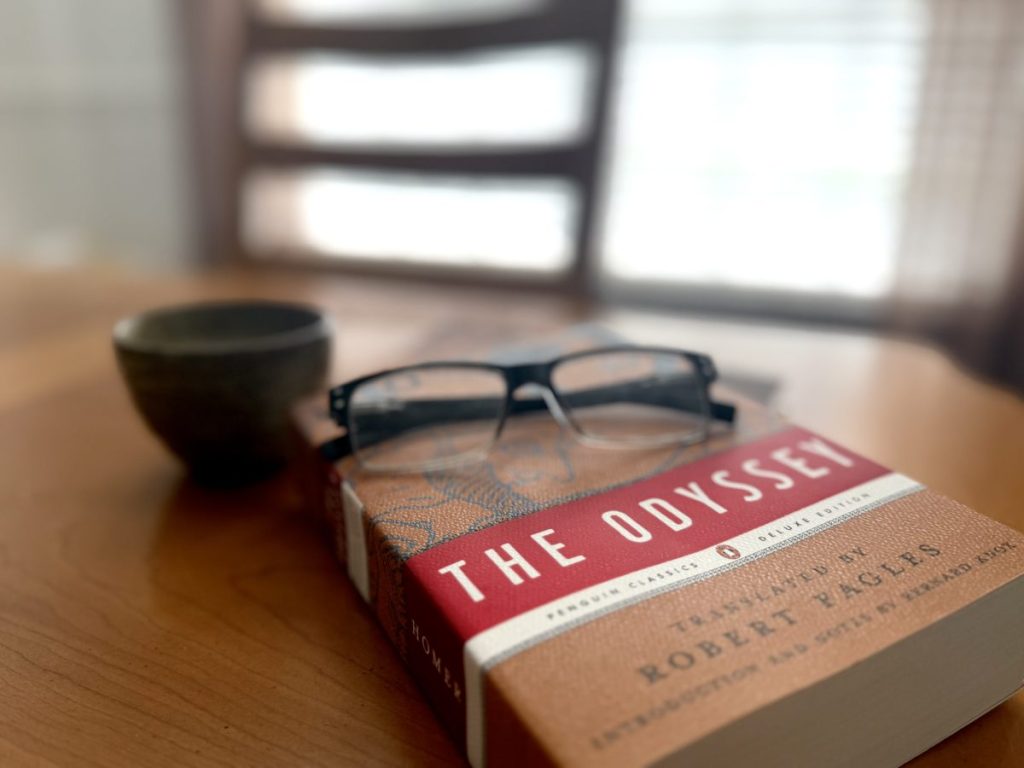
The Literary Spine brought me first to The Iliad — and having finished it ahead of schedule, I arrived at The Odyssey right on time, returning to the windswept shores, the restless seas, and the long road home. Beginning with the first of April, the reading plan gives me the freedom to adjust along the way, allowing for other novels I may be exploring alongside this grand project. Having now completed the first two books, I can already say my intimidation is quickly eroding away and the sheer joy of the story is taking its place.
In Book 1, I found it striking that even within a polytheistic, mythological world, a profoundly familiar human tendency emerges — one found just as readily in monotheistic traditions like Christianity — the impulse to blame God for our misfortunes. Beginning around line 37, Zeus himself speaks these words in Fagles’ translation:
”…how ready mortals are to blame the gods. It is from us, they say, that evils come, but they even of themselves, through their own blind folly, have sorrows beyond that which is ordained.”
How true this remains. We so often point upward when things go wrong, when in reality it is our own choices and the consequences of our own blind folly that bring so many of our sorrows. Reading ancient texts has a way of reminding us how little humanity has changed across the millennia.
Continuing through Book 1, I paused again at lines 80 through 84, where Homer first references the blinding of Polyphemus the Cyclops. My mind immediately traveled to the Museum of Fine Arts in Boston — specifically Gallery 144 in the European Art wing — where the Swiss painter Arnold Böcklin’s 1896 masterwork Odysseus and Polyphemus hangs on the wall. This is precisely why a broad and curious engagement with the arts matters: the more we nourish our experiences across literature, painting, music, and history, the richer and more deeply connected each new encounter becomes.
Sailing into Book 2, I found myself contemplating another timeless truth. Around line 230, Mentor stands before the assembly and laments:
“Think: not one of the people whom he ruled remembers Odysseus now, that godlike man, and kindly as a father to his children!”
This is a sobering observation about the nature of legacy and human approval. Mentor’s grief is not simply that Odysseus is gone — it is that a good and generous man, one who led with the tenderness of a father, has already been forgotten by those he served. How many of us pour our energy into managing the perceptions of others, working tirelessly to be well-thought-of, only to discover that approval is a shifting tide? The real question is not what others think of me, but what kind of person am I actually becoming — because that is the character that endures, long after the applause fades.
If you have not yet made time for Homer’s works, I want to encourage you — whether you are young and just beginning to build a life of the mind, or further along the road and looking to deepen it — pick them up and begin. They are far more accessible than their reputation suggests, and you are free to read at your own pace. This is not a race to the final page. It is a slow, rewarding voyage — and the sea, as Homer well knew, has much to teach us.
I’ll be sharing this voyage in the weeks ahead, as The Odyssey continues to unfold.
 The Curious Table