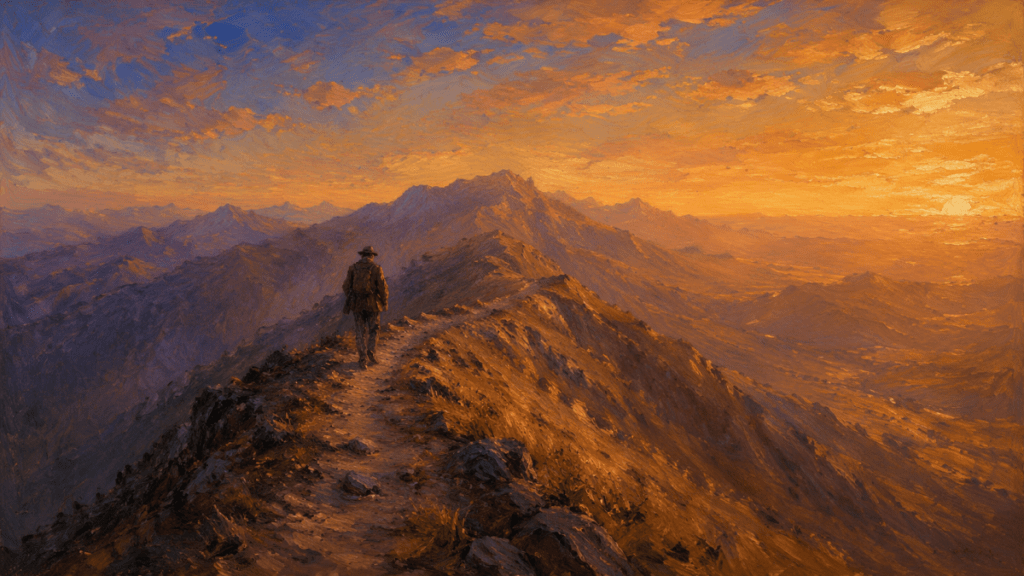
AI-generated image · Created with ChatGPT for Feature Image
I’ve spent my retirement years reengaging with books, coffee, cuisine, and culture across the world. From reading books I was supposed to have read in high school to building friendships with those interested in arts and culture I found new interests laying near the surface and free time to pursue them. But I soon discovered it wasn’t the free time that opened the door — it was allowing curiosity to rekindle within me. Shortly after that curiosity took hold the books started landing on a list to read, visits to museums and reading the gallery labels increased, and visits to cafes and restaurants not associated with a chain began to occur more often.
However, when it came to my reading growth, I didn’t have a clear understanding if I was on the journey I desired — and just maybe the most adventurous thing a reader could do wasn’t to read more, but to read further back. This year I decided I wanted to undertake something that would expand my literary pursuits in a similar manner as my approach to coffee, arts, cuisines, and travel. What would be equivalent to the growth in my understanding of coffee, spices, art, and cultures of the last several years?
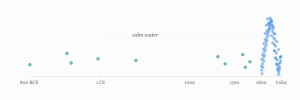
At the end of 2025 I utilized a feature in GoodReads, an online tool I use to track the books I read, to see better what my reading habits were. When I pulled what is similarly known as a scatter chart (see above), of the publication years of my reads, I was surprised to see a heavy concentration of books 1800 till now. Yet before 1800 there was literally a spattering of about 5 or 6 dots. What literature resided in that calm water nestled outside the channel of my reading journeys? I assumed that at the foundation of my reading, there would be a strong European connection, and then second there would a strong influence of early empires. And that was the revelation! I want to follow the Western spine of literature from Homer to Milton, searching for how virtue takes shape within the long memory of human experience. In that arc—from pagan epic to Christian epic—I’m drawn to how each work refines the vision of the good, the true, and the beautiful. What may unfold is not just a shift in belief, but the evolution of literature itself as a vessel for moral imagination. Enter the room … The Iliad and The Odyssey.
Fast forward through some research and tools and you will find a “Project Plan” for 2026 that takes me through Homer (The Iliad and The Odyssey), Virgil (The Aeneid), Dante’s Divine Comedy, and John Miltons Paradise Lost. Having just finished The Iliad and currently a few books into The Odyssey, I have left the assurance of my familiar shore and find myself enjoying fresh excitement of a new journey.
The journey will take us through Homer’s Iliad and Odyssey, Virgil’s Aeneid, Dante’s Divine Comedy, and Milton’s Paradise Lost — from ancient Troy to the gates of Heaven itself. However, we should be prepared to accept the weight of these epic poems and works, and thus the containers for these blog posts must increase to properly give them the air to breath. The extra words, thus length of posts, should reward our time around this table sharing our curiosity.
I want to share my journey not only with what I’m reading, but reasons why I’m reading this, and approaches I’m taking to what may appear as a daunting task (it sure seemed that to me) and turns it into almost bite-size morsels of this elephant. I ensure you my goal is to encourage to finish with me. Even if you just start now, you too can plan the journey to fit your schedule and your pace and still sit at the table and share.

