
There are books you read and set aside. And then there are books that change your itinerary.
A few days before my family and I left for Paris, I finished A Moveable Feast — Ernest Hemingway’s memoir of his years as a young, nearly penniless writer living in the city in the 1920s. I’d been meaning to read it for years. The timing turned out to be everything.
By the time we landed, I wasn’t arriving as a tourist with a list of monuments. I was arriving with a guide — one who had walked these same streets a century before me, sat in these same cafés, and written about Paris with the particular honesty of someone who loved it completely and couldn’t quite afford it.
The memoir sent me to Les Deux Magots first. Hemingway haunted that stretch of Saint-Germain-des-Prés, and so did the broader circle of writers and thinkers who defined what we now call the Lost Generation. I knew from my reading that Café de Flore was just steps away — the slightly more intellectual cousin, people said, to Les Deux Magots’ bohemian energy. I chose Les Deux Magots because Hemingway did.
I sat at one of those crowded sidewalk tables with an espresso, watching people move along the pavement — the particular rhythm of Parisians who are neither hurrying nor dawdling but simply present in their city. And I found myself wondering, sitting there, whether this was how Hemingway gathered his characters. Whether he sat in exactly this posture, watching exactly this flow of people, and found the faces that would eventually populate his pages. It felt entirely possible. It still does.
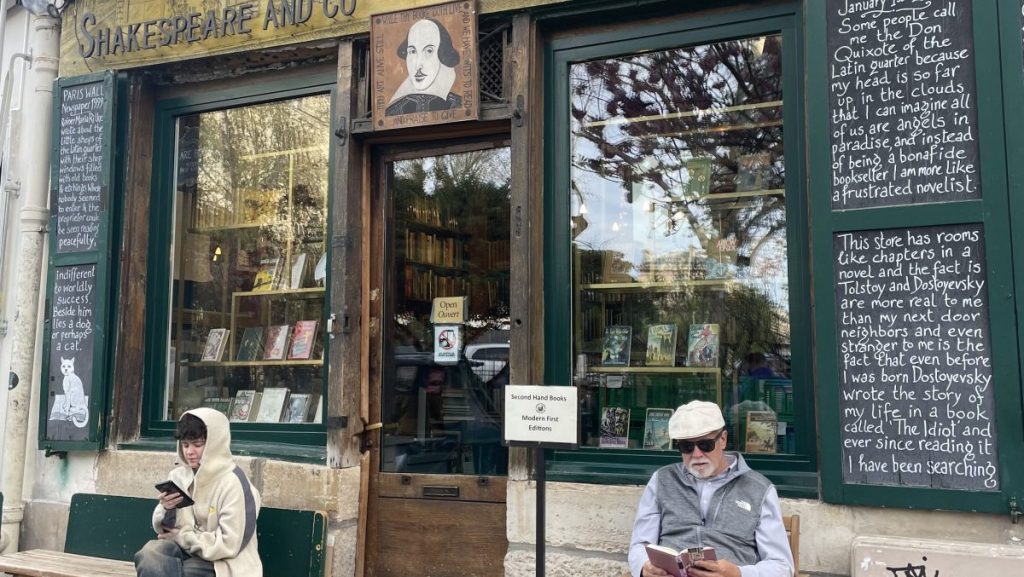
From there, the memoir sent me across the Seine to the rue de la Bûcherie — to Shakespeare and Company.
Hemingway had been a close friend of Sylvia Beach, the American woman who founded the original Shakespeare and Company and ran it as both a bookshop and a lending library. For a young writer with almost no money, that lending library was oxygen. He wrote about it with a particular tenderness, the way you write about a place that helped you survive.
I found a small table just outside the door and sat down. Inside I had purchased a copy of Rilke’s Letters to a Young Poet — the Charlie Louth translation, a edition new to me, which matters because I collect this book. I have several copies in different translations and I return to it the way some people return to certain pieces of music. Finding a new translation inside Shakespeare and Company, in Paris, felt like exactly the kind of thing that was supposed to happen there.
So I sat outside the door — you can see me in the photograph above, the fellow on the right in the gray vest — and I read. The city moved around me. I didn’t rush.
Later we made our way to the Luxembourg Gardens.
Hemingway walked there for inspiration, for the particular kind of thinking that only seems to happen when your feet are moving and something beautiful is nearby. My wife and our two daughters and I settled onto a bench and did what he might have recognized — we simply watched. The Gardens in the early evening have a quality that is hard to name. People are unhurried. Children sail toy boats on the fountain. Painters set up easels at the water’s edge.
It was one of those painters who stopped me.
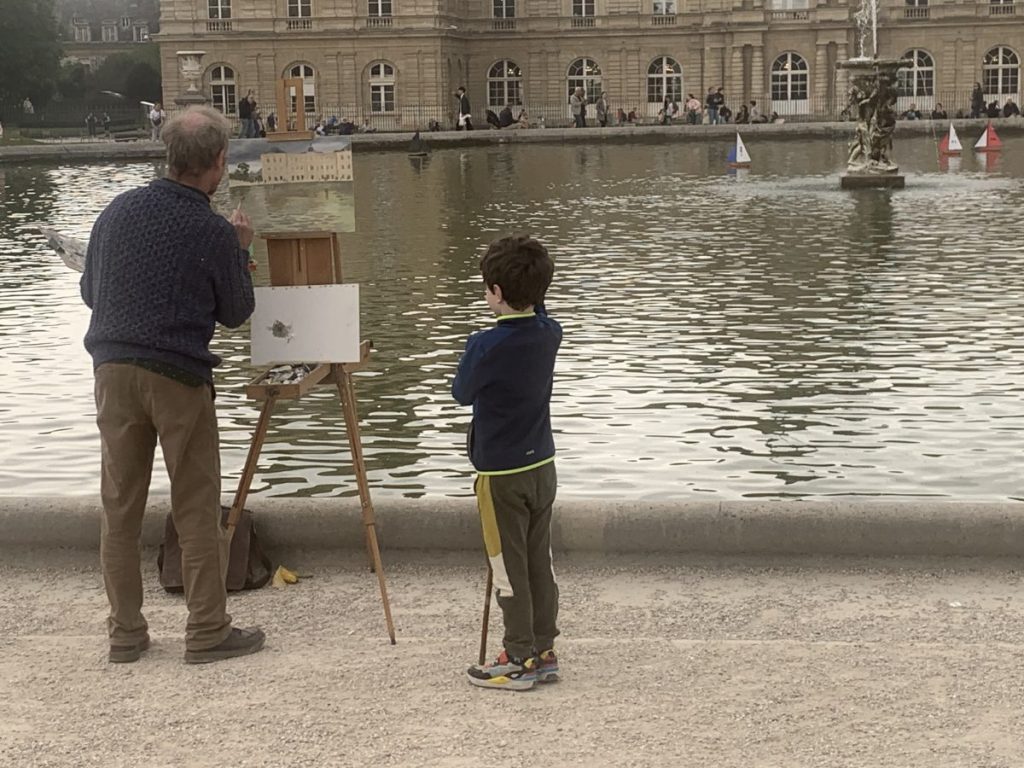
An older man stood at his canvas beside the Grand Bassin, brush in hand, working quietly. Beside him, completely still and completely absorbed, stood a small boy — watching every stroke, learning without being taught. I raised my camera without thinking.
I’ve looked at that photograph many times since we returned home. What I feel when I look at it is simple and not simple at all — a connection, and a somberness about my own responsibility to be available to the next generation. To stand at the easel. To let the young ones watch.
Hemingway wrote about Paris as a place that stays with you. He was right about that. But what stayed with me most wasn’t a café or a bookshop or a garden. It was a painter and a boy at a fountain, and the quiet question the image has been asking me ever since.

