Think about the last time something stopped you. A sky that went orange at the edges. A song that found you at exactly the wrong — or right — moment. The way a room feels after someone leaves it. You noticed. You felt something shift.
That’s where poems begin.
I decided at the start of 2026 to try writing poetry. Not because I thought I was ready, but because it felt like the natural next step in a reading life that keeps pulling me toward new territory. The more we read, the more we begin to sense that certain things can only be said in certain ways — and poetry has been saying them that way for a very long time.
Many of us arrived at poetry earlier than we realized. The Psalms in the Hebrew scriptures are poems — cries of grief, songs of praise, images so compressed and honest they’ve lasted thousands of years. We read them and something in us responds before we’ve even processed the words. That’s poetry doing what prose simply cannot.
I’ve come to think of a poem as closer to a painting than a story. It doesn’t ask you to follow a plot or arrive at a conclusion. It offers an image, a sound, a turn of phrase — and then it simply waits. It invites you to stand there for a while and see what rises in you. That’s not intimidating. That’s generous.
Mary Oliver, whose poems I’ve been spending time with this year, wrote a slim practical guide called A Poetry Handbook — not about mystical genius, but about the actual craft anyone can learn: sound, line, image, revision. It’s a quiet, encouraging book. But here’s what I want you to know before you go looking for it: you don’t need it to begin. You can start exactly where you are.
Try this. Look at whatever is in front of you right now. A parking lot. A kitchen sink full of dishes. A tree outside your window. The way afternoon light falls across your living room floor. Let yourself notice one color, one movement, one feeling that scene stirs in you. Then write four to six short lines. Don’t worry whether it’s good. Just give yourself permission to play.
You might be surprised by what appears on the page.
Here is what appeared on mine.
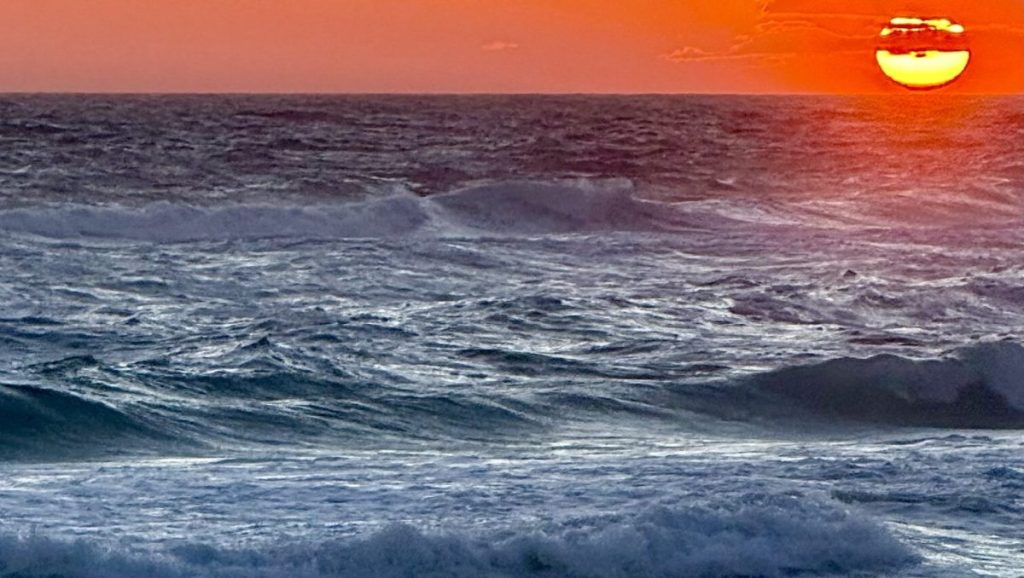
On a February afternoon in Seaside, at the end of a stormy day, I stood at the ocean’s edge and watched the sun go down. The wind was strong. The sea was loud. I had my notebook. This is what came:
Weight of the Setting Sun

A sky of orange, sea of white,
The wind exhales its boundless might.
It speaks of those who meet their strife,
And guide the storms that shape their life.

Past storms that shape but do not break,
The heart learns all the soul can take.
When sunrise clears away the pain,
What once was loss becomes great gain.
It’s not a perfect poem. But it’s honest — and it was written standing exactly where the photograph above was taken, on the same February afternoon, watching the same sun find the water.
That’s enough. That’s always been enough.
Whatever form calls to you — poetry, painting, music, the arrangement of words on a page — I hope you’ll answer it. Not because you’re ready. Because you already know more than you think you do.
You always did.
 The Curious Table