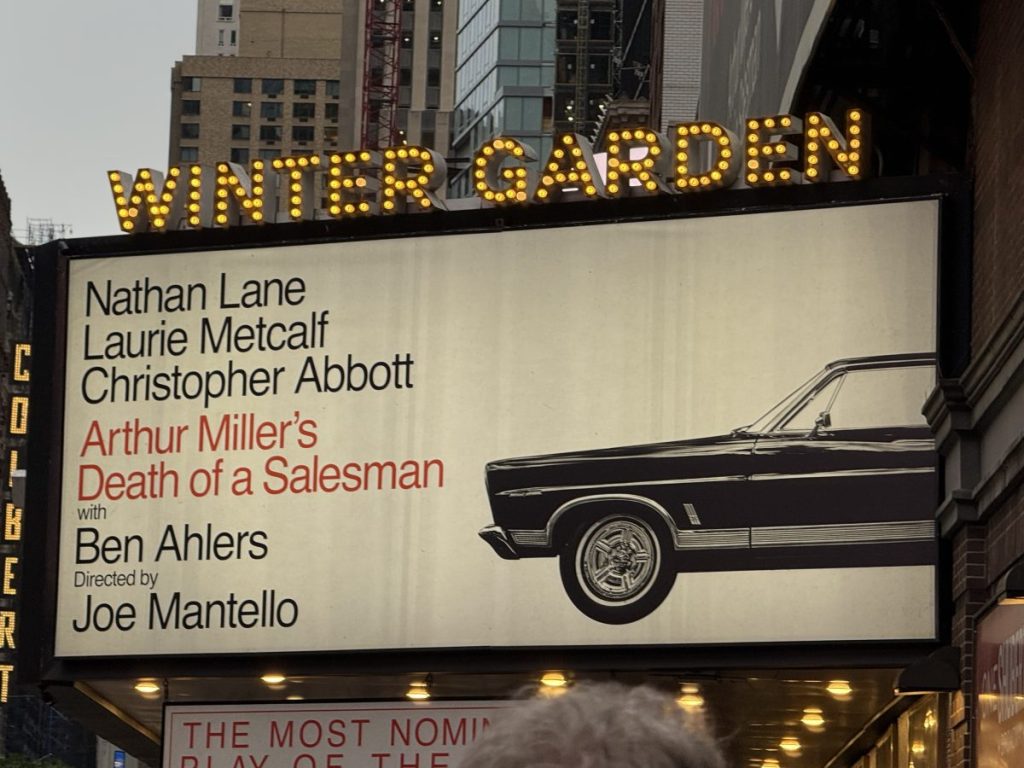
There’s something fitting about returning to Arthur Miller’s Death of a Salesman at this point in my life and no longer encountering it as assigned reading but choosing to step back into its world with a bit more perspective. My first exposure came in high school, where the play’s themes of ambition, identity, and disillusionment felt more academic than personal. Revisiting it over the past year, along with watching the 1985 film adaptation, gave me a deeper appreciation for Miller’s ability to capture the quiet unraveling of a man chasing an increasingly fragile version of the American Dream.
Before that curtain came up, I found myself wondering how that familiarity would shape the experience. There’s a difference between understanding Willy Loman and feeling him. Between analyzing his choices on the page and witnessing them unfold in real time, embodied by an actor, in a shared space filled with strangers. Theater has a way of collapsing that distance, of making something immediate and human in a way that even a strong film adaptation can’t fully replicate.
However, having just completed Homer’s The Odyssey, I was also beginning to look at stories and see just what kind of hero lives in a story. This day, the hero I would be watching closely would be Willy Loman. And the questions would be, what kind of hero will he be? How will this performance present the hero wrestling with a world that may have been changing around him while he was meandering through his life? I was ready to receive answers to these questions.
Then the house lights went down.
Before I knew it the house lights came up, the standing ovations were fading, and the crowd was moving.
And then I realized, in that brief 5-minute window opening onto the streets, before the city pulled me back completely, I was still in the theater. What struck me most was how differently certain moments landed compared to my previous experiences with the text and film. Not always easy as theatre has no pause button, or the ability to turn back a few pages to refresh a thought. Scenes that I thought were familiar carried a new kind of weight on stage, shaped not just by the actors’ interpretations, but by the immediacy of live performance: the pauses, the silences, the subtle reactions that can’t be fully captured on the page.
In Homer, Odysseus is “exceptionally clever and cunning”. The master of the Trojan Horse and the hero whose name is attached to a victorious war and a monumental homecoming poem. Yet the Odyssey is as much a catalogue of his misjudgments… taunting Polyphemus and bringing Poseidon’s enmity on himself, ignoring or mishandling divine advice, losing companions through his choices, as it is of his triumphs, so that greatness and failure are braided together in one life. Willy, too, is never simply a fraud; he possesses a real, if modest, talent for connection, a salesman’s theatrical warmth, and a genuinely tender (if distorted) desire to provide for his family. But like Odysseus, he narrates himself into a myth he cannot inhabit: Odysseus boasts his name to the Cyclops when anonymity would save his men, and Willy clings to the fantasy of being “well liked” and indispensable when the economic world has rendered him almost invisible. Each man’s self-story actively worsening the reality he must then live in.
Where Homer’s hero is ultimately capable of recognizing loss, accepting limits, and reentering ordinary life, returning not as a conquering king only, but as a scarred husband who must reclaim his household with patient craft, Willy cannot complete that turn toward truth. And so, his final “Nostos” becomes not a homecoming but a car crash: a last, deluded attempt to convert his failures into posthumous greatness through insurance money, the tragic modern inversion of the epic kleos (glory) that Odysseus only reluctantly and partially renounces.
I didn’t just revisit a story I already knew… it was reframed for me on that stage. And in doing so, it reminded me why certain works endure: not because they stay the same, but because we don’t.

