This is part of a series. To find the Table of Contents for this series start by clicking here.
I did not expect Homer to spoil me so thoroughly.
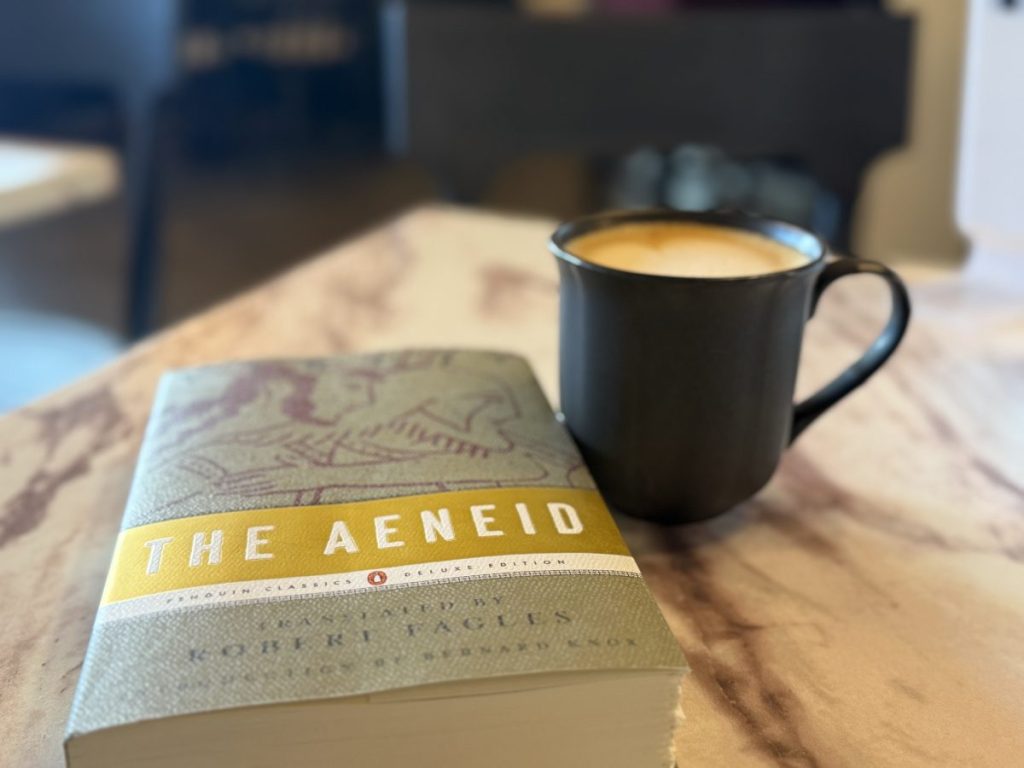
After months with the Iliad and the Odyssey, those wild, wind-torn worlds of Achilles’s rage and Odysseus’s wandering cunning, I turned the first page of Virgil’s The Aeneid expecting something familiar. What I found instead was something strangely different and, in some ways, more unsettling. Homer’s heroes burn brightly and selfishly; they fight for personal honor, for glory, for the sheer ferocious joy of it. Aeneas fights because he has no real choice. He is a man crushed beneath the weight of destiny, duty, and the cruelty of gods who cannot leave mortals alone. Four books in, I find myself less interested in summarizing what happened than in sitting with what reading it is doing to me.
The first thing that will not leave me is the extraordinary casualness with which these ancient people blamed their gods. Juno despises the Trojans and stirs a storm at sea in the opening lines, nearly drowning Aeneas before his story has properly begun. Venus manipulates Dido through the agency of Cupid, engineering a woman’s catastrophic love as a tactical favor to her son. The gods in the Aeneid are not distant or disinterested; they are meddlesome, petty, and personal, and the mortals know it. They curse them, bargain with them, and attribute nearly every misfortune to divine interference.
What strikes me is how honest that feels, even to a modern reader. Many of us have traded polytheism for monotheism, but the impulse has not changed much. When things go badly, a diagnosis, a loss, a relationship that collapses, the reflexive move is still to look upward and ask why. We dress it differently; we call it theodicy, the problem of pain, or we simply say, “I don’t understand what God is doing.” But the emotional architecture is identical to Juno throwing storms and Aeneas shaking his fist at heaven. The ancient world is not nearly as foreign as we might like to believe. They were blaming the gods. We are asking God why. The address has changed. The conversation has not.
The second thing pressing on me is a renewed appreciation, perhaps a defense, of myth itself. We live in an age that is intensely suspicious of any narrative that cannot be verified with a footnote. If it is not historically documentable, we are quick to dismiss it as legend, fiction, or worse, manipulation. But the Aeneid is pushing back hard against that instinct. Virgil was not writing a history of early Rome; he was writing a founding myth designed to teach Roman readers what it meant to be Roman, to value pietas, sacrificial duty over personal ambition, the community over the self. The story is doing moral and cultural work that no census record or military dispatch could accomplish.
C.S. Lewis understood this. He argued in his essay “Myth Became Fact” that myth can convey a truth more potently than cold analytical argument ever could, that a story can make you feel a truth before you have even articulated it. Tolkien agreed; he believed, as he told Lewis directly in a famous midnight walk that shifted Lewis toward Christianity, that there is always something true inside a myth, even a pagan one. Jesus himself taught in parables, deliberately chosen fictions built to carry moral freight that a direct statement could not bear. To dismiss a story because it is “not literally true” is often to miss the only truth the writer intended. Virgil was not confused about whether Aeneas was a real person. He was shaping a people’s sense of themselves, and he was doing it with art.
This brings me to what I keep circling back to as I read these four books: the theme of burden. Aeneas is famously, repeatedly pictured carrying things, his elderly father Anchises on his shoulders out of burning Troy, his household gods clutched in his hands, his young son Ascanius by the side. He carries the past, the present, and the future simultaneously, and it is killing him slowly. He is not a cheerful hero. He is a man who has lost everything and is still expected to build a civilization from the wreckage.
There is something in that image that reaches straight across the centuries. Most of us know what it is to carry more than we feel capable of carrying, grief, obligation, the expectations of people who came before us. What Virgil seems to be saying, and what I am only beginning to understand, is that the carrying itself is not incidental to the story. The carrying is the story. Our load is our story.

