I promised you “the rest of the story.” Here it is. And I will warn you upfront: it is not a comfortable place to land.
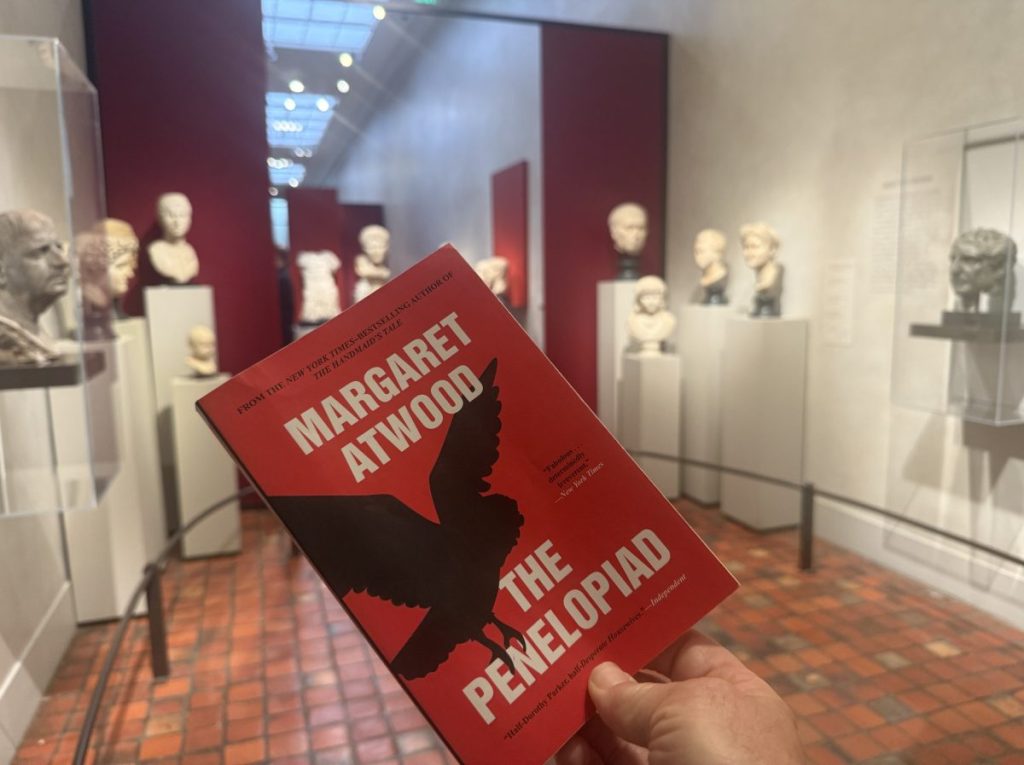
When I closed Part 1 of this series, I told you that the further I moved into The Penelopiad, the more the Odyssey lens would shift from clarifying to uncomfortable. I did not fully understand how right I was. I had been living inside the architecture of Penelope’s world — watching Atwood trace its walls and beams with a precise, almost surgical intimacy. I understood, by that point, that Penelope was a woman defined by her relationships to others in a world that never asked of her husband what it demanded of her daily. What I was not fully prepared for was the moment when Atwood turned the lens and asked me to look at what Penelope herself could do with the little power she held.
Chapter 12 is where that reckoning begins — and it hit me like cold water.
Penelope’s offhand comments in “Waiting” about selling off the babies of her enslaved maids — sparing only a “pretty child” — tear away any illusion that she sits neatly outside the brutal logic of her world. You cannot read those lines and keep her cleanly in the victim column. She is both shaped by that system and complicit in it, even as she herself is constrained, traded, and evaluated within the same patriarchal economy. Her threat to slap Eurycleia “if she’d been younger” peels back another layer: this is a hierarchy among women, not just between women and men. Age, rank, proximity to power — these determine who gets to mete out cruelty and who is expected to absorb it in silence. Atwood does not flinch, and she does not let us flinch either.
This is the conundrum I have been sitting with since I closed the book. Atwood is clearly working to surface the biases leveled at women in the ancient world — the moral double standard, the accountability gap between Penelope’s enforced fidelity and Odysseus’s well-documented wandering. She does that brilliantly, and Part 1 of this series walked through how Homer’s own architecture made that double standard visible once you had the Odyssey lens to see it. But there is a second kind of bias threading through The Penelopiad that is slipperier, and I think Atwood herself may be more ambivalent about it than she is about the gender question. The bias of cultural and social rank — the hierarchy of status — shows up not only in what is done to Penelope, but in what Penelope does. And she does it with something closer to comfort than reluctance.
I must hold both of those truths at the same time. Penelope as victim, yes. But also, Penelope as someone who learned to survive by wielding the very tools that have wounded her and the women beneath her. That is not a flaw in Atwood’s vision. It is, I think, the most honest thing about it.
And then comes Chapter 13.
Atwood’s shift into full, formal poetry at that precise moment in the narrative is not an accident. She is stepping deliberately onto Homer’s own stylistic ground — at the exact moment when the stakes for both Penelope and the maids are becoming impossible to ignore. She is reminding us that epic, song, and chorus have always been instruments of power. And now she is claiming them. The poem recounts the familiar architecture of heroic journeys and domestic loyalty, while quietly exposing the cost borne by the anonymous women who populated the background of the original telling. Atwood is not merely narrating resistance in that chapter; as Penelope states in the Shanty, “”I’ll spin a thread of my own.”. She is performing it — placing herself beside Homer as an equal maker of myth rather than a respectful commentator at his feet. It is a counter-epic, built in the master’s own form, insisting that the tradition is large enough — or must become large enough — to hold women’s voices as more than echoes.
That move landed on me with significant force. I have said throughout this journey that Atwood handed us a key before we knew there was a door. By Chapter 13, she has done something more. She has walked back inside the house that Homer built — through the front door, not the side entrance — and rearranged the furniture.
My final note, and I mean this as the most honest summary I can offer: Atwood’s work here is phenomenal. Not perfect — I think the question of class and status remains a slippery slope that the book navigates somewhat unevenly — but phenomenal in the way that only work with real moral seriousness can be. She gave Penelope her own voice. She gave the twelve maids their chorus. She asked hard questions about who tells the story, and why, and whose silence gets built into the architecture of every tale we call canonical.
I leave The Penelopiad carrying a Penelope I did not expect: not simply patient, not simply wronged, but fully human — capable of endurance and complicity in the same breath. That is a more complicated Penelope than Homer gave us. It is also, I suspect, the truer one.
As for Paul Harvey — now you know the rest of the story.

