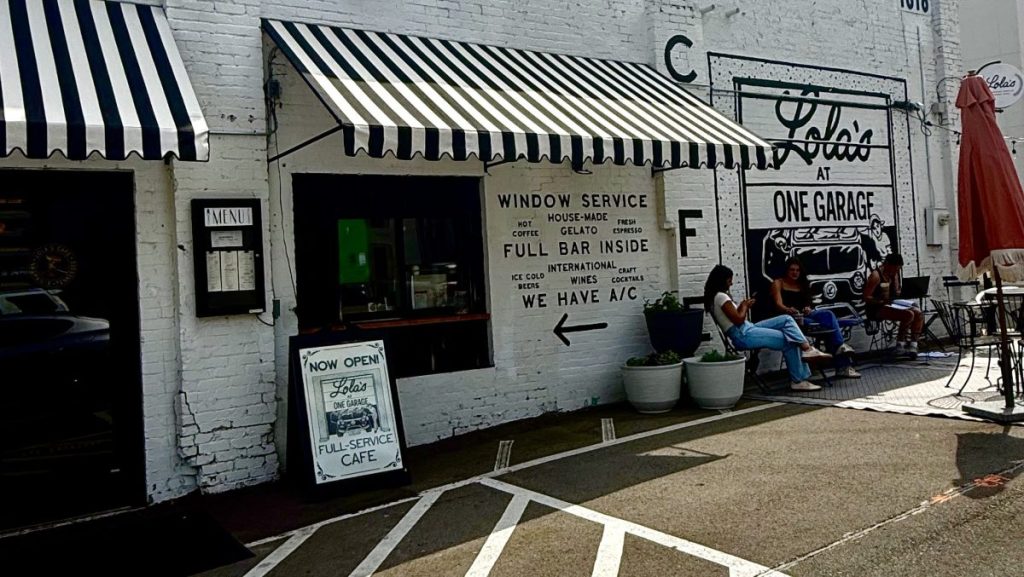
In my retirement as I have continued to allow the horizons of my interest to expand, the opportunity to visit an exhibit of Impressionist art is always welcomed and if possible pursued. Recently an Impressionist exhibit from the Dallas Museum of Art was showing at the Frist Art Museum here in Nashville. TN. So, with a family member coming for a visit we all ventured into Nashville and made a day of it. Of course, as with any “outing” it required a stop for coffee to start the day. We ventured to Lola’s European Café on Broadway in the Midtown area. Lola’s has wonderful coffee and pastries to start the day and with the welcoming interaction with the staff, it always adds to any experience in the area. Now, on to the Frist …
Upon arriving and moving into the exhibit, I immediately encountered a couple of Monets I had never seen. However, Claude Monet’s The Pont Neuf painted in 1871,
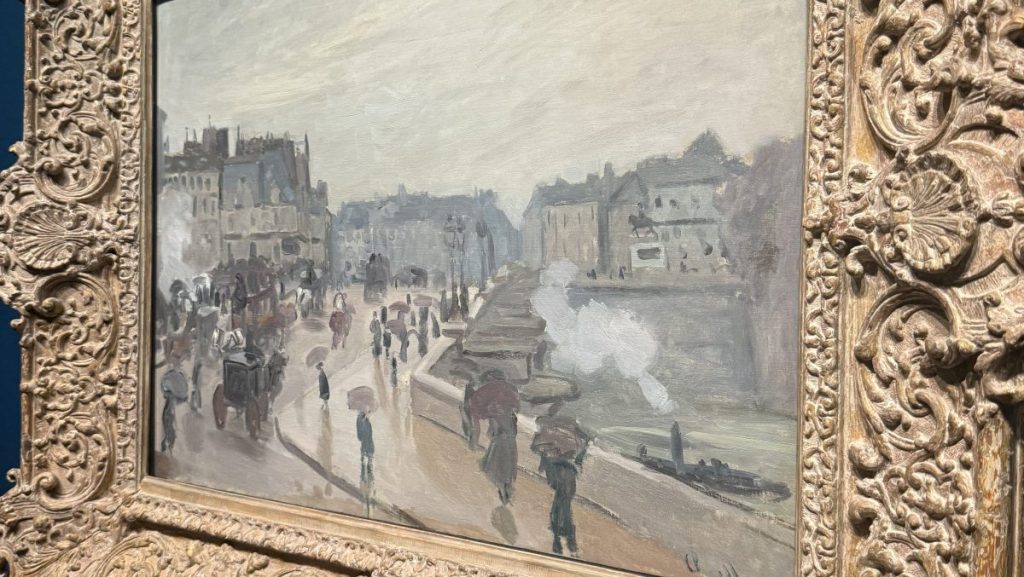
was the one that gently brought me to a stop. I knew I felt something within me stir as I stood there peering into and around that scene Monet had laid onto that canvas many years prior. The Pont Neuf (French for “New Bridge”) is the oldest standing bridge in Paris, spanning the Seine River at the western tip. Why was I staring at it so long? Why did I shift my body to the side and view the painting from an angle? Was it an attempt to look down that road the way Monet looked down it? As if the angle might let me in. To quietly reflect on the rain-washed scene of carriages crossing the bridge and figures moving through the rain. The muted palette of warm grays and the shimmering reflections on the bridge’s stones drew me into a hushed intimacy, as though Monet is lovingly cradling a wounded city back to life with his brush. Why that phrase? Why wounded? As I often do, when I stopped and felt the pull of the scene on me physically and emotionally, I pulled my phone from my pocket, connected to the museum’s wireless network, and searched out some background on Monet and this painting.
Monet painted The Pont Neuf upon returning to Paris in the autumn of 1871 — a city still reeling from the devastation of the Franco-Prussian War and the brutal suppression of a violent worker’s uprising — making it the only work he produced during that sorrowful homecoming. Notably, unlike Renoir’s sun-drenched version of the same bridge painted shortly after, Monet’s is essentially painted almost entirely in shades of gray — a stark visual elegy for a capital stripped of its former grandeur and confidence. However, there was something beyond the history behind this painting pulling my attention. What is it I continued to question.
Suddenly I realized… I have been there. While Monet’s muted grays and blurred figures reflect a Paris shattered by war and revolution, for me it was a reminder of our family trip there in 2024. While there are carriages, the painting whispered to me, maybe more via its name than the presence of any landmarks, that I had crossed that bridge. Then I reviewed my trip and realized that my visit to the bookstore Shakespeare & Company was just down the street about a half mile. A piece of art from long ago and a memory made in Paris just 2 years ago now reside side by side.
This is why I am so inclined to encourage all those around me to be willing to open wide our eyes and emotions and seek an interconnected world through the arts. At the highest level we are all humans, we have so much in common, and I think the arts help to bring these commonalities together in visible ways. As we were completing our visit there was an open book of empty pages with a pen attached on a small table. You were invited to write how this exhibit may have influenced how you see our world through the works of these masters of their craft. Here is what I penned on that paper…
I came here to see one of my favorite art movements… Impressionism… it and the Renaissance period are both phenomenal moments in the work of man’s creativity
Our creativity!
After hours of shimmering light and dissolving color in the works of Sisley, Signac, Seurat, and Pissarro, I returned to Monet’s painting I paused in front of at the beginning of the visit. Standing in front of it again this quiet, gray canvas holds you in one last moment of soft, wordless peace, a final breath of au plein air serenity before the world reasserts itself. Standing before it in a kind of quiet goodbye, storing its gray luminous stillness like an ember kept warm in the pocket. Then the museum doors opened, and the sidewalk received us back into the blunt clarity of the afternoon — clean lines, solid walls, the unforgiving sharpness of things — like waking from a tug of reverence into a world where light no longer shimmers but simply shines.

