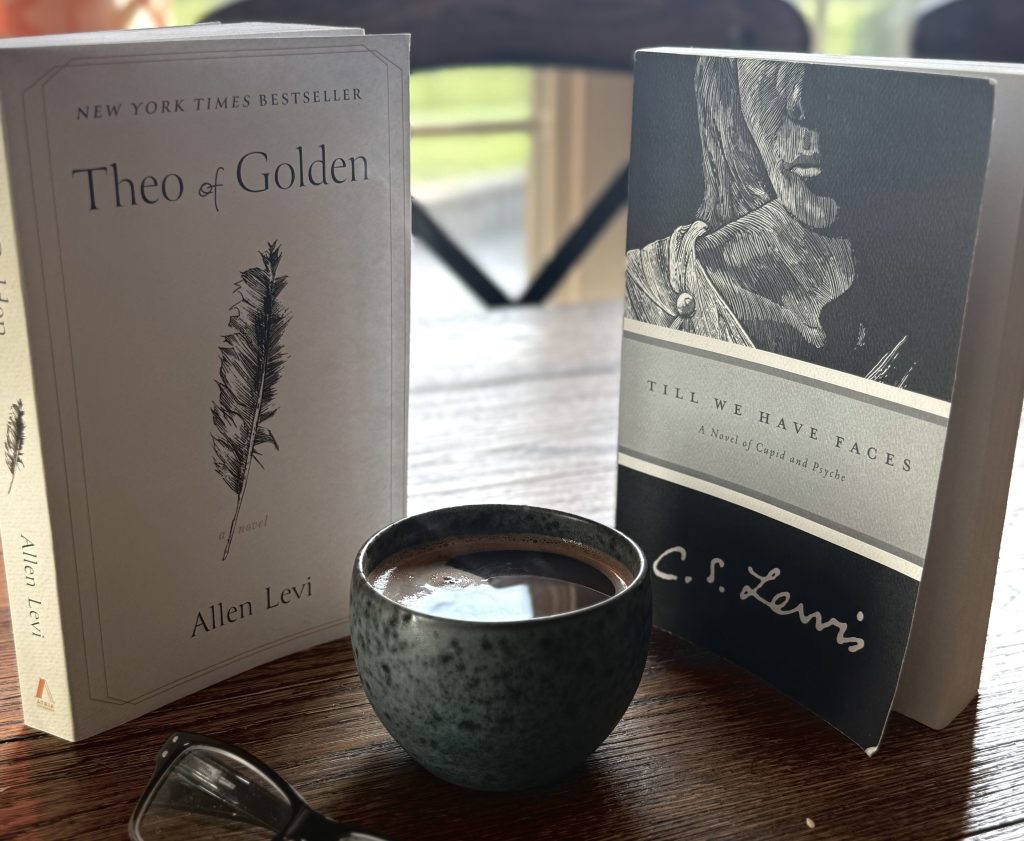
There are moments in reading when a book reaches across the page and grabs you by the collar — not with a shout, but with a whisper. That is what Theo of Golden did to me. Then again, unexpectedly, that same book quietly sent me back to a very different one I had read not long before.
Let me start with Theo. If you have not yet met him, let me introduce you. He is an elderly, mysterious man who settles into the small Southern town of Golden and begins doing something remarkable. He buys pencil portraits of local residents from the local coffee shop — ninety-two of them hanging on the walls — and one by one, he tracks down each person and gives them their portrait. He calls them the “rightful owners.” It’s as if Theo is restoring a face captured within a frame behind the veil of an intimate coffee shop. What begins as a simple act of generosity becomes something profound. Each exchange opens a door. Each face on paper becomes a doorway into a real human life.
Throughout the novel, Allen Levi returns again and again to this idea of the face — of being seen, of being known, of mattering to someone. It threads through the story the way a river threads through a valley, quiet but constant. Theo watches people. He notices them. He seeks out the weary and troubled. He sits with a night custodian named Kendrick at a fountain bench and treats him, perhaps for the first time in a long while, as a person rather than a function. There is something almost holy in that kind of attention.
Then comes Chapter 50, and everything converges.
Theo writes a letter to Asher — the artist who created all those portraits — and in that letter, he shares what he calls a “lovely homily” about faces. It is the moment in the book where all the scattered threads of theme come together in one place. Like a quilt being finished and spread out for the first time, you can suddenly see the whole pattern. The homily speaks to something ancient and universal: the way a newborn infant turns its face instinctively toward the face of its mother, searching, longing, needing to be recognized. And then Theo makes the quiet, devastating observation that none of us ever really outgrow that longing. We spend our whole lives, no matter our age, searching for a face that will look back at us with love.
I am 67 years old, and I will tell you plainly — that hit me somewhere deep.
And then, in that very moment, another book came drifting back. C.S. Lewis wrote a novel near the end of his life called Till We Have Faces, and it is, at its heart, the most searching question I have ever encountered put into story form. His main character, a queen named Orual, stands before the gods at the end of her life and asks: How can they meet us face to face till we have faces? It is her cry of complaint against the gods who never seemed to speak plainly or show themselves fully. But Lewis, with the wisdom of a great author, slowly reveals that the real question runs far deeper than she realized. Before the divine can look us in the face, we must first drop our veils, our masks, our borrowed voices, and become truly ourselves.
What strikes me is how beautifully these two books, written decades apart and wildly different in style, are asking the same question from opposite sides. Levi’s Theo shows us what it looks like when one human being decides to truly see another — to hand them back their own face and say, You matter. You are known. Lewis’s Orual shows us what it costs to be truly seen — by God, by others, and most painfully, by ourselves.
For those of you who are younger than I am, hear this: do not wait until you are old to learn the art of really seeing the people around you. Theo did not give those portraits as a retirement project. He gave them because he understood, bone-deep, that every human face carries a story worth honoring. Start now. Look up from your phone. Learn the names of people others walk past.
For those of you who are, shall we say, closer to my end of the timeline: do not think for a moment that you are too old to drop your veil. Lewis wrote Till We Have Faces late in his career and called it his most mature and masterful work. There is no expiration date on becoming more fully yourself.
Two books. Two faces of the same truth. I invite you to read both and bring your thoughts back to the table.

