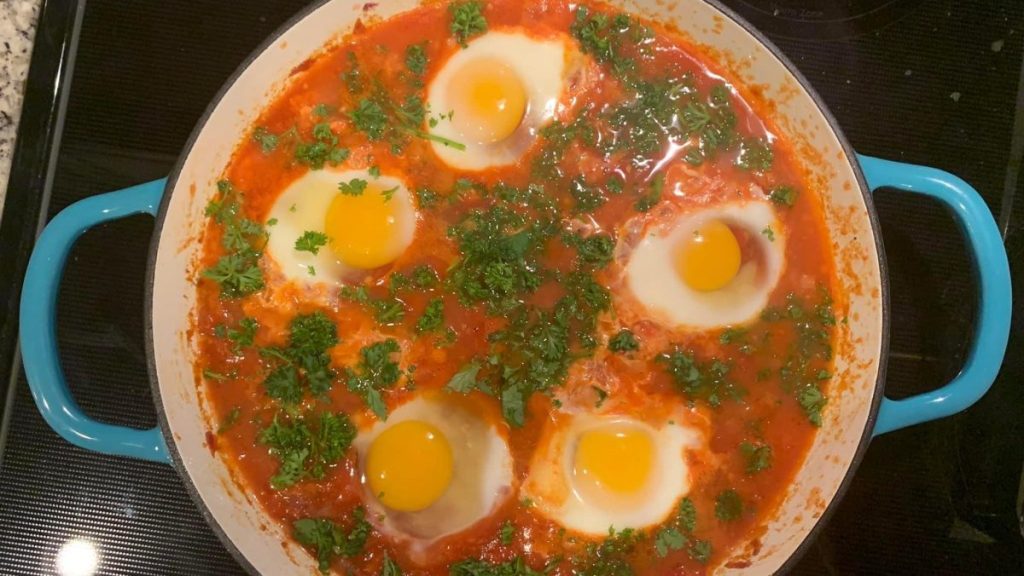
Shakshuka — Shakshouka — when we hear that word, many of us may awkwardly reply, “Bless you.” The word may be neither familiar or comprehensible to many of us, yet it carries a very warm and welcoming experience when invited to table.
The word Shakshuka originated in North Africa and literally means “all mixed up” in both Hebrew and Arabic, but in time it came to represent something less “mixed up” but intentionally pulled together. Today, the word refers to a popular North African and Middle Eastern dish of eggs gently poached in a savory sauce of tomatoes, chili peppers, and onions, seasoned with spices like cumin and paprika, and often topped with fresh herbs and feta cheese.
I have personally experienced this dish in Boston at Bar Vlaha, as well as making it personally at home. At Bar Vlaha, make a reservation for the chef’s table where they will seat you and you can watch as lamb is roasting on the spit over an open flame as they deliver your dish to the table. As their website states, “Bar Vlaha captures the true soul of Greek cooking with rustic and nomadic traditions using charcoal and open fire gastra techniques.” Every visit confirms what I first suspected — this dish is worth the reservation. The beauty of dishes like this is the freedom one is invited to adjust, add, subtract, some of the spices to make it your own personal experience, as well as an experience you can share with others. To sit with others and engage in a warm and flavorful dish of Shakshuka, is to truly experience a piece of the culture that lives behind this dish. The Mediterranean culture in which this dish calls home exudes naturally with a deep hospitality. A hospitality that invites others into the home, while extending a very warm and receptive welcome; much as your taste buds will respond to spoonful of this dish.
If you’re curious about shakshuka’s history—its North African roots, how New World tomatoes changed the dish, and how it became so tied to Israel—this deep dive does a nice job sorting what’s documented from what’s just repeated tradition, that’s the curious rabbit hole I went down after falling in love with this dish.
This blog is not a blog of recipes; the Internet is choked full of that. I want to invite all of us to search for experiences through our books, our travel, many cultures, and art. While cooking is often considered to be a mere necessity, a means to satisfy hunger and nourish the body, I seek beyond its practical aspects. I ask if cooking reveals itself as a genuine art form that encompasses creativity, passion, and the mastery of flavors. Just like a painter meticulously blends colors on a canvas, a chef orchestrates ingredients to create culinary masterpieces that tantalize the senses and evoke emotions. I invite you to consider with me a closing thought.
Cooking is not just about producing sustenance; it’s a testament to the human capacity for creativity and innovation. Like any other art form, it has the power to captivate, provoke thought, and stir emotions. From the choice of ingredients to the presentation on the plate, cooking is a canvas where we paint our culinary visions. So, while maybe not every time, consider stepping into the kitchen with a mind to create “your” experience, don’t just cook—engage in art and feed both the body and the soul. You may even use the wealth of information we have at our fingertips on the Internet to peek behind tonight’s meal and see what history and culture you find to add to your experience. Pull up a chair, there’s always room at our table for one more.

