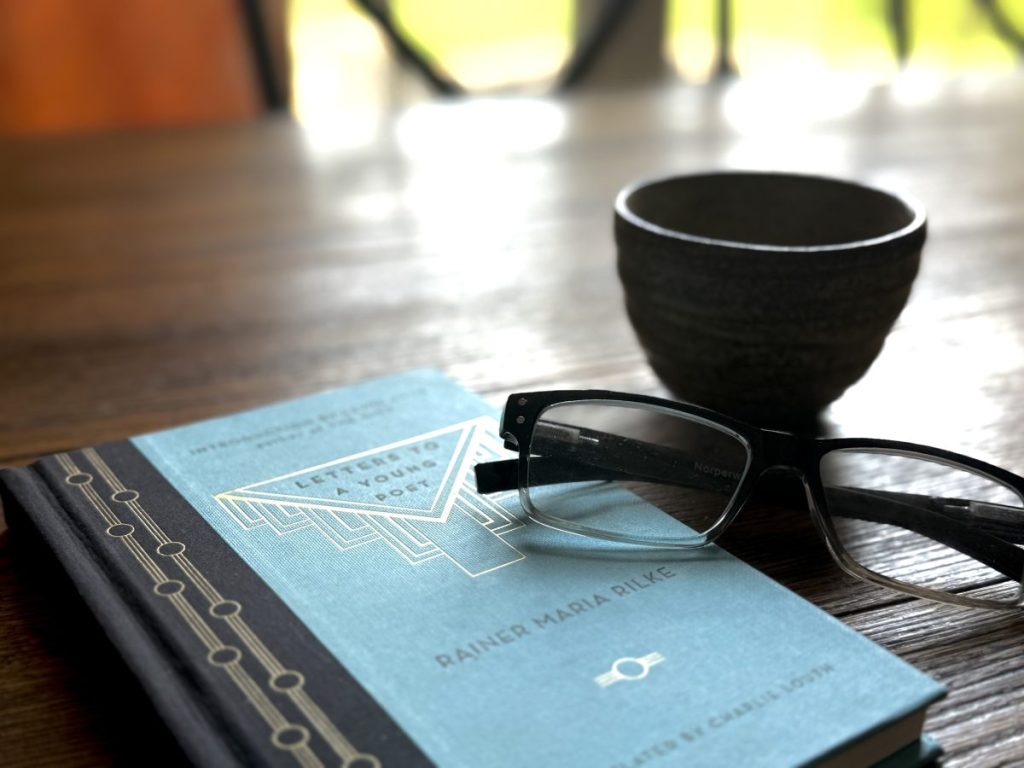
There’s something about sitting with a cappuccino that invites honesty. Maybe it’s the warmth, or the quiet ritual of holding something steady while everything else feels uncertain. Gathered here around this table—books half-open, notes scattered, maybe absently tracing the rim of my cup—and the conversation turns, almost inevitably, to Rilke. Specifically, Letters to a Young Poet. (Also, this related post of mine may be of interest as well.)
While the letters were written between 1902 and 1908, they were compiled and published in 1929 by the recipient, Franz Xaver Kappus, three years after Rilke died of leukemia in December 1926. A gift to us, offered by a young man Rilke had clearly shaped.
Not all of Rilke, just the beginning. The first letter. The question that starts it all: Should I write?
It’s a question that sounds simple until you sit with it for more than a moment. Around this table, we may all recognize it. Not just in writing, but in everything that feels like calling. Should I teach? Should I stay? Should I begin something I’m not sure I can sustain?
Rilke’s response is almost frustrating in its refusal to give a direct answer. He doesn’t say yes. He doesn’t say no. Instead, he turns the question back on the one asking it—and, by extension, on us. Almost rabbinical in nature?
Go inward, he says.
And that’s where the conversation shifts. Because going inward is not what most of us are trained to do. We’re used to feedback, to metrics, to some visible sign that we’re on the right path. Even here, with coffee and books and thoughtful company, there’s a quiet temptation to look around the table and measure ourselves against each other.
But Rilke dismantles that instinct almost immediately. He insists that no external authority can answer this question for us. Not critics, not teachers, not even other writers. The only valid answer must come from a deeper place—one that requires silence, patience, and a kind of honesty that feels, at times, almost severe.
We may very well respond how unsettling that is. If the answer must come from within, then there’s no shortcut. No reassurance. No quick clarity.
And yet, there’s something freeing in that, too.
Because if the answer doesn’t come from outside, then neither does the permission. We don’t need to wait for approval. We don’t need to prove ourselves first. We simply need to ask the question seriously enough—and live with it long enough—that the answer begins to take shape in our life.
That’s when we may approach the line we keep circling back to: live the questions now.
It sounds poetic, but around this table we may start translating it into something more practical, almost stubborn. Living the question means continuing to write even when we’re unsure. It means showing up to the page, to the classroom, to the work, without the guarantee that it will resolve into something clear or successful.
It also means resisting the urge to force an answer too quickly. Rilke seems to suggest that clarity is not something we seize, but something that grows—quietly, almost imperceptibly—over time.
By the time the cups are empty, and the conversation has softened, we may well recognize that no one has found a definitive answer, but that no longer feels like the point. The question itself has become something worth keeping.
And maybe that’s the quiet gift of Rilke’s first letter. Not that it tells us what to do, but that it teaches us how to remain—patiently, attentively—within the uncertainty of … becoming.
For me, it has led to me writing and sharing my journeys on this blog. I answered my question internally, why write? I wonder what question you are living with.

