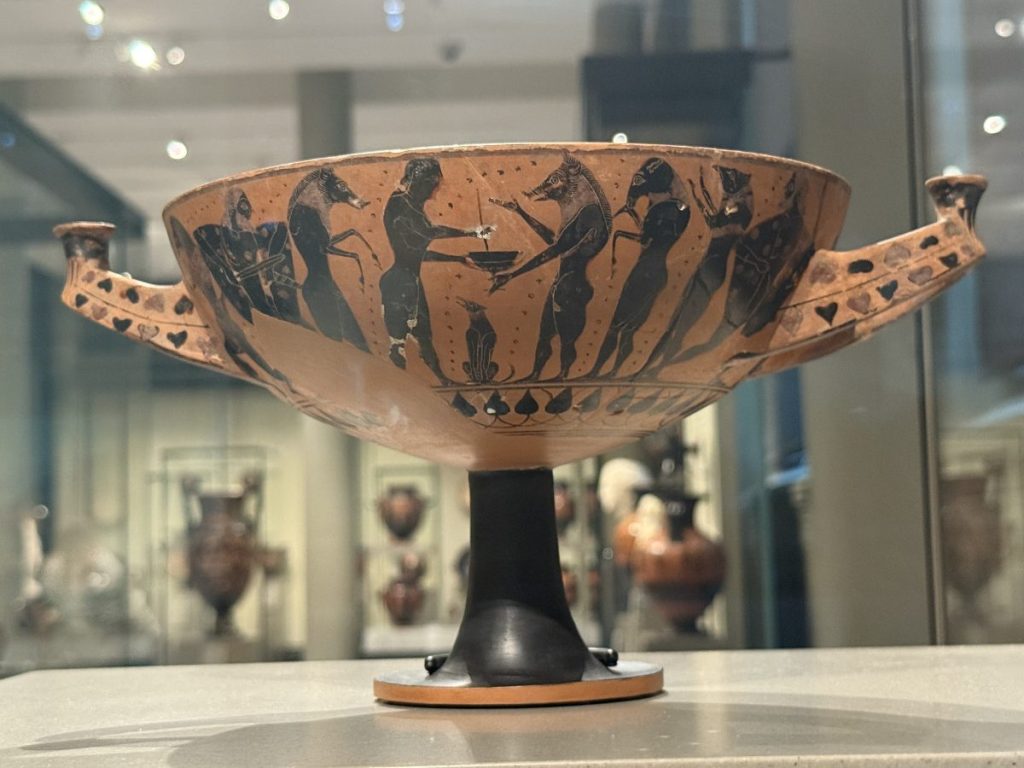
Painter of the Boston Polyphemos, Greek (Athens), Archaic period, about 550 BC. Drinking cup (kylix) with Circe transforming Odysseus’s men. Ceramic, black-figure technique. Museum of Fine Arts, Boston. Accession 99.518. Personal photography.
This is part of a series. To find the Table of Contents for this series start by clicking here.
Book 11 stopped me. Not gently — the way a good sentence stops one mid-sip — but hard, the way a feeling does when it has been waiting for you to catch up with it. The tension I ran into was stretching my view of Odysseus: here is a man who worries, deeply and openly, about whether his wife has been faithful back in Ithaca — while he has not sent word that he is even alive and… well, let’s just say he has been having himself a decent time with the ladies. Off I went, researching what it meant to be a “faithful” wife versus a “faithful” husband in the Bronze Age world. I even found myself reading about how those same expectations were laid out in Hebrew scripture of the same period. I was not looking to discount scripture — only to sit with the concept, and with the tension, inside a world that was unapologetically patriarchal.
This concept, I came to understand, has a name scholars use: the sexual double standard in ancient Mediterranean culture — and it operated on a remarkably consistent logic across Greek, Near Eastern, and Hebrew cultures of that period. It is less that we have a responsibility to study this history exhaustively and more that we have an invitation to sit quietly with it… in our own culture. Homer reaches across the centuries and shines a light into our present moment. Can we talk about it in a way that eases that tension? Not by ignoring it, but by discussing it honestly — moving forward, not endlessly hashing out the past.
While that tension was still settling, memory pulled me somewhere else — to a small apartment in Boston, about a year before I ever picked up The Odyssey. Out of books to read on my wandering into coffee shops, I had eased into my daughter’s bookshelves and found in my hand The Penelopiad by Margaret Atwood. In that novel, Penelope — Odysseus’ wife — narrates her own story from the Underworld, alongside the voices of her twelve hanged maids. I did not realize it then, but that read was conditioning me for Book 11 almost twelve months before I decided to embark on this journey. This seems to happen more often the more we read — and we become more appreciative each time we recognize it. It opens our eyes to receive what we would not otherwise have seen. Atwood named what Homer left unnamed, and she handed me a key before I even knew there was a door.
But Book 11 was not the only place where that Boston bookshelf reached out to prepare me. As I turned into Book 12, another author arrived uninvited — and welcome. The Sirens appear in this book: mythological creatures whose enchanting song lures sailors to their doom. Odysseus has his crew plug their ears with wax and ties himself to the mast so he can hear without being drawn in. It is a clean moral episode — about temptation, self-control, and the discipline required to survive both. Then, from that same daughter’s shelf, six months earlier: Kurt Vonnegut’s The Sirens of Titan.
Vonnegut’s sirens are not creatures — they are the alluring mysteries of the universe itself, the forces that draw people toward something greater, sometimes at the cost of their free will. Where Homer’s episode is moral (resist the temptation; make the right choice), Vonnegut’s is philosophical (how free is the choosing, really?). Homer presents literal mythic beings symbolizing perilous temptation; Vonnegut uses the same concept to probe the illusions that guide humanity. Vonnegut is a lens here, and a good one — but the ship we are sailing is still Homer’s.
So, what do I carry into Book 13?
I carry Penelope differently now. I hear her silence in the epic not as patience, but as a kind of radical endurance — the performance of faithfulness inside a system that never asked the same of her husband. Atwood named that, and I cannot un-hear it. I carry the Sirens differently, too — not just as obstacles to be lashed against, but as questions about why we want what we want and how much of that wanting is truly our own. And I carry something quieter underneath all of it: the suspicion that Homer knew exactly what he was doing, that the wanderings on the surface and the longing underneath were always the same journey. That is what WanderLust means to me now — the map is the wandering, but the territory is the ache. Transformation continues even in my own mind in my own time.
But beyond what it has accomplished in me, I am looking forward to seeing how Odysseus, while not giving that tension a name maybe, allows his transformation to continue. Has something possibly stirred deep within him in the same way change does in us? One little event at a time? A suggestion by another accepted? A caring for someone at a risk to our own desires? Exactly what is Homer up to? Let’s go see and I’ll join you back here soon…
 The Curious Table